After the memorable spring of 2019, with a new future awaiting me in Canada that fall, I was determined to make the most of my summer holiday cravings. Following a short stop in Romania, my first destination was once again Switzerland. But not Zurich this time. Instead, I was heading to the western French-speaking part of the country — Lausanne. And as I would soon discover, it felt like stepping into unexpected tropics in the heart of Switzerland.
I went there to visit Eddy, my close friend from university back in Denmark. He had recently moved to Lausanne to begin a PhD at the local university.
Tropical Switzerland
The weather was blisteringly hot. Not just hot, but humid-hot. Tropical hot. This was June 25th, and summer was already in full swing. I had just landed in Geneva, and the heat hit me like I’d stepped into a steam room. I’m guessing the 30 degrees and the massive lake had something to do with that. Still… it was Switzerland. I hadn’t expected such heat in Switzerland of all places. Back in the summer of 2008, when I went camping in the mountains, I didn’t recall it being anywhere near this intense.
Arriving in Lausanne on a hot summer day
In any case, I arrived in Lausanne and quickly met up with Eddy at the university. He gave me a tour of the campus and introduced me to some of his new friends before wrapping up his work for the day. Soon after, we made our way to the Lausanne Aquarium.
Diving Into AQUATIS: A Freshwater Odyssey
After our walk and settling in, Eddy suggested we visit AQUATIS Aquarium-Vivarium in Lausanne, where I hoped we’d get to cool off a bit. The aquarium was split into different sections reflecting different biomes, and we started out in the tropical one which felt just wonderful: more heat, more humidity, waves of warmth and mist pressing in…
Eddy was in his element and I looked like the crazed uncle—the humid heat was getting to me.
Just what I dreamed of after escaping the scorching sun outside. Stepping through that door was like entering a steam room of nature. On the bright side, when we emerged from it, the Swiss heat suddenly felt much more tolerable.
Free me, human, and I will grant you your heart’s desire!
AQUATIS is Switzerland’s large freshwater aquarium-vivarium, a place that doesn’t just show fish, but builds entire environments. The building spans some 3,500 square meters over two levels, with dozens of aquariums, terrariums, and vivariums.
A prehistoric grin under the waves
The biomes take you from the Rhône’s glacial sources, through Alpine rivers, along Lake Geneva, and all the way to tropical wetlands, mangroves, Asian rivers, African Great Lakes, Amazonian rainforest—and even Oceania’s ecosystems.
Mongoose/Meerkat pups
Among the many species on display they even had one of my personal favorite reptiles. The King of all living lizards today—Big daddy Godzilla himself… or herself… I guess she might have been a female. Regardless, none other then the famous Komodo Dragon!
Look at that cute little dino-face giving me the sass!
It had been forever since I’d gone to any aquarium, and seeing all those colorful aquatic species—fish flashing, tropical plants dripping moisture, amphibians perched or creeping, reptiles sliding through their tanks—was a real treat to behold.
A colorful display of shallow sea life
After sweating through the tropical greenhouse, the cooler Alpine and freshwater biomes felt wonderfully refreshing. The shift in temperature and atmosphere was immediate—soft blue lighting, rippling reflections, a calmer rhythm in the air. It was a relief after spending so much time in the heat outside, and it made the experience even more immersive.
A shy axolotl peaking from around the corner
We lingered over the axolotl display for a while trying to find the critter. After a while the fella peaked around the rocks with a goofy grin and frilly gills sticking out like antennas. It looked part dragon, part cartoon character. Just another Pokémon.
Preparing for the Next Day
After the aquarium, we headed to the train station to catch a ride to where Eddy was living — a quiet spot just outside Lausanne in the countryside. I also had to figure out what to do the following day since Eddy would be working. There was no shortage of things to see in the area, but to get around I’d need a travel pass.
Walking through Lausanne
Like everything else in Switzerland, the cost of the pass was steep. Still, it offered unlimited access to all sorts of transportation: trains, buses, and even ferries. As stingy as I could be, my trip there was a once in a lifetime experience, so I could convince myself to forget about the cost that time.
Beautiful old castle remnants all over the city
With the pass in hand, I pulled up Google Maps to get a sense of the landscape and attractions nearby. And there were plenty! The railway line along the shores of Lake Geneva promised a scenic ride through several picturesque towns, stretching from Lausanne all the way to Veytaux. Castles, museums, famous casinos and more awaited.
Sunshine & Exploration: Arriving in Montreux
The next day was just as hot. On the flip side, you couldn’t ask for a more beautiful, sunny day to spend wandering the Swiss coast of Lake Geneva. Early morning, I hopped on the train in Lausanne, heading to Montreux.
Lake Geneva with the Alps in the background—what a sight!
I had no real idea what the place was all about. On the map it just looked like a resort-y town you get off the train in, soak up sun, maybe eat ice cream. As it turned out, Montreux had a seriously rich history. It’s made up of three formerly separate communities (Le Châtelard, Les Planches, and Veytaux) that merged in 1962, and lies along several kilometres of lake shore, protected by mountains that shelter it from strong winds. Because of its setting, natural beauty, and mild climate, Montreux long ago became one of Switzerland’s most fashionable health resorts.
Montreux—must be an amazing place to live in
To top it off, Montreux is famous in my book because it was a favourite haunt of (among others) Freddie Mercury. Yes, that Freddie. He frequented Montreux and was deeply connected to the Casino Barrière and the old recording studio there.
Casino Barrière Montreux & The Queen Studio Experience
Naturally, I felt compelled to visit the casino—to walk in Freddie’s footsteps. The Casino Barrière Montreux isn’t just a pretty building by the lake; it played a part in rock history. I wasn’t there to gamble, simply to soak in the vibe. Fun fact: this was the first casino I’d ever stepped foot into… and of course it had to be a place that’s been graced by rock royalty.
Statue of Freddy Mercury in Montreux
Inside the Casino is Queen: The Studio Experience, which used to be Mountain Studios, the real deal where Queen recorded many of their albums from around 1978 through the 1990s. The studio was theirs between 1979 and 1993.
‘A Kind of Magic’ vinyl and iconic stage costumes
The museum is a gem. Memorabilia everywhere—handwritten lyrics, costumes worn on stage, instruments, promos, photos, tape boxes (some marked with early, even abandoned titles). The control room is preserved more or less as it was (there’s even a reproduced Neve mixing desk so visitors can try remixes of Queen classics).
‘Made in Heaven’ memorabilia at the Queen Studio Experience
One cool highlight: in the “Made in Heaven” room, you stand in the very spot where Freddie laid down his final songs. It’s emotional but in a grounded way—less shrine, more quietly powerful.
Freddie Mercury’s handwritten lyrics and heartfelt reflections on Montreux
One surprise after another, Montreux was impressing me more and more by the minute. My next stop would be a lakeside castle on the far-eastern end of town, Château de Chillon.—but more on that in a bit.
A Medieval Break: Château de Chillon
One thing I absolutely love about travel passes is that you can constantly hop on and off rides. This definitely made my day a lot easier rather than having to walk long distances in that merciless sun. Still, by the time I reached Veytaux at the far eastern tip of Montreux, I was sweating buckets. What better way to cool off and escape the glare, than by stepping inside a medieval lakeside castle?
The bridge entrance to Château de Chillon, Montreux
Château de Chillon sits on a rocky islet just off the shore of Lake Geneva, connected to the mainland by a wooden bridge that creaks slightly underfoot — charming, a little rustic, and perfect photo material. The castle has been there for a very long time: the first written records go back to around 1150, though archaeological digs show that its rocky base was used even in the Bronze Age.
The little moat-like part of the lake surrounding the castle
Walking over the wooden bridge you pass by the surrounding moat-like defenses (though it’s more of a lake boundary than a full moat in the stereotypical sense). You enter into the inner courtyard — stone walls, towers rising overhead, a hushed kind of grandeur. Inside, there are underground rooms with Gothic vaults built into the rock itself; these were used as armories, stores, and then later dungeons.
A historic cannon stands guard in the ancient stone halls of Chillon Castle
Beneath the elegant towers and stone courtyards lies a dungeon where countless prisoners once languished in the damp shadows. The walls are etched with names, prayers, and perhaps curses—ghostly echoes of people who never made it out. Iron grates, thick chains, and a single wooden pillar with a shackle still stand as chilling reminders of what went on below.
The Castle of the Counts of Savoy
One room that stuck with me was the prison of François Bonivard, a Genevan monk and political prisoner who was chained to a pillar for years by the Duke of Savoy. The pillar is still there—simple wood, scarred and old—with a single iron chain dangling from it.
Wooden pillar in the castle dungeon that shackled François Bonivard
Lord Byron later immortalized Bonivard’s story in his poem The Prisoner of Chillon, even carving his name into the wall himself when he visited in 1816. Standing there, I couldn’t help but picture the flicker of torchlight, the echo of chains, and a poet scribbling notes in the dark.
The view from the uppermost tower was quite something
Chillon wasn’t always a prison, though. For centuries, it served as a luxurious lakeside residence and strategic fortress for the powerful Counts of Savoy. Its position—guarding the narrow road between Lake Geneva and the Alps—made it a key checkpoint for trade and defense.
Centuries old wall murals highlighting the French heritage of the castle
These days you’ll find a surprising blend of military architecture and aristocratic elegance in the castle museum—inner courtyards lined with Gothic arches, murals still faintly visible on faded walls, and massive oak barrels once filled with Savoy wine.
I assume these barrels were decorative, but they sure looked yummy!
Somewhere in a corner room, I stumbled upon a guestbook and couldn’t resist signing it—adding my name to the long list of travelers, dreamers, and history nerds who’d been captivated by the same walls.
I wonder if they still have this old guestbook laying around there
Before leaving, I caught a view through the barred prison window: the lake shimmering outside, and a little French ferry sailing past. For a moment, the castle’s past and present felt intertwined—centuries apart, yet somehow connected by that same stretch of water.
French ferry of freedom seen trough the oppressive grate of the dungeon
With half the day behind me, I had learned so much about Montreux and its history, both old and more recent. However, my tummy was rumbling, and I had to find a place to eat soon. Not an easy task when you’re on a budget in one of the most expensive places in the world! Those exact thoughts running through my head, with travel pass in hand, I suddenly had a crazy idea: since ferries were included, why not hop across the lake to France and eat cheaper? The ship was right there, showing me the way from between the dungeon grates!
Bonjour France!
As soon as I made my way back to Lausanne, I headed straight for the port to catch a ferry. Ferries across Lake Geneva between Switzerland and France ran quite frequently, so I didn’t have to wait long at all. The crazy twist came when I realized where in France I’d end up—it wasn’t just any border town, but one of the most famously pricey spa resorts in the country: Évian-les-Bains.
Even the ferries there had this retro-luxurious look to them. What a place…
Yes, that Évian—the birthplace of the world’s most overachieving bottled water. Nestled at the foot of the French Alps, Évian is a charming lakeside town known for its Belle Époque architecture, therapeutic springs, and air of old-world elegance. A place where people once came “to take the waters,” and where today, the waters come to you—in a plastic bottle with a designer price tag.
I did not see this coming when I started planning my summer travels
Still, no matter how expensive, France was cheaper than Switzerland! And here I was—a soon-to-be humble PhD student, still unemployed at the time, somewhat thriving on savings from my old student cleaner job and Danish unemployment benefits (thank you again, Denmark)—casually ferrying across Lake Geneva to have lunch and explore Évian. I couldn’t believe it. It all felt so surreal!
Another ornate casino on the opposite side of Montreux, across the lake
Yet there I was, strolling along the sunlit resort streets, then sitting down at a lovely patio on a cobblestone lane, ordering my meal. Man… life was good. Such a powerful feel-good memory—one that still makes me smile from ear to ear as I write this years later.
My cheap late lunch in France after a day of exploring Switzerland
After a leisurely late lunch, I started feeling thirsty. And being in Évian, what else could I do but find the public spring of the famous water itself and fill up my bottle straight from the source? The taste was incredible—fresh, crisp, and delightfully pure. Hydration never felt so poetic.
The holy fountain of fresh liquid wealth. Even the statue can’t handle it
Now that I knew what liquid luxury tastes like. I was ready to become a millionaire!
Late in the Day
I spent a bit more time exploring Évian before heading back to Lausanne. Soon enough, I met up with Eddy to relay my wild adventures of the day. He absolutely loved it—especially the part about taking a boat all the way to France just to find a slightly cheaper meal. The stingy student spirit never dies.
Walking back to the ferry dock on the French side, Alps in the background
We spent the rest of the evening hanging out at his place. If I’m not mistaken, I had a plane to catch super early the next morning from Geneva—and since trains didn’t run all night, my options were limited. I’d have to catch the last train around midnight and spend the night at the airport.
One last look across Lake Geneva—wondering if I’ll ever go back there again
That night marked the beginning of many airport sleepovers to come. I even started ranking airports by “overnight comfort level” later on. Midnight came sooner than I expected, and by the skin of my teeth I managed to catch the last train. Would’ve been pretty stupid to miss that one!
Although my time in French-speaking Switzerland was short, it was wonderfully sweet. If it weren’t so bloody expensive, I’d go back in a heartbeat.
Following my trip to Budapest I returned to Denmark to continue my unemployment streak. Around this time, I first dipped my toes into the waters of cryptocurrency investment. This was also around that time that I would take my second shot at New Zealand. Above all else, the end of the year would mark my return to Canada for a short family visit in December. I would soon get my first taste of a Canadian winter.
How did we get to cryptocurrencies?
It might seem like this came out of nowhere, but this moment was one of those fateful events in life that would have long term ramifications for me.
I had known about cryptocurrencies for years before 2018. I had seen the crazy surge of bitcoin in the past years and wished I could have gotten in at a good time. However I never had money to throw away on such a gambit. I also didn’t know of a safe and easy way for Eastern European citizens to tap into this young new market. If you remember those days, buying crypto meant wiring money to shady exchange websites — many of which, like BTC-e, ended up scamming their clients’ funds.
Or get scammed or hacked later… depending on your luck
By 2018, however, the winds were shifting, and this once-marginal asset class was gradually gaining acceptance worldwide. More secure exchanges with easy fiat on-ramps were springing up left and right, like Bitpanda in the EU. In this steadily growing pro-crypto climate, I found myself hanging out with a couple of friends when the topic of cryptocurrencies came up. After a few drinks and a shared blunt, I allowed myself to be convinced that this was the perfect time to get in on the action. The market had corrected for the most part of the year and enthusiasm for a multi-year bull-run was creeping back.
The next day I registered on a crypto exchange and deposited my first 50 euros with great financial hopes and dreams for the future.
Hopes and dreams…
Speaking of hopes and dreams, November arrived—bringing with it the one day each year when New Zealand immigration opened its working holiday visa portal to the world.
Strumming along and dreaming of sunny new horizons
I had made a list with my personal details for me and a few of my friends that were going to help me apply. The challenge was to fill out the immigration web-forms as soon as fast as humanly possible in hopes of getting me my coveted visa. The moment the portal went live, the website crashed. Like every year before, millions of candidates from across the world flooded New Zealand immigration servers.
Try as I might, I could never get passed the first page without it freezing or crashing, and having to reload the thing. One of my friends managed to advance to the next pages, but once again the website crashed and sent him back to the start. It was a complete shit show. Five minutes later the portal was closed and a disappointing message filled the screen—the yearly quota had been filled.
This second gut-punch would be my final attempt to move to the dreamy lands of Middle Earth. All hopes and dreams I had for New Zealand were now shattered for good.
Questioning my career path
More than a year had passed since I successfully defended my Master’s thesis, yet my job prospects remained as bleak as ever. I was seriously questioning my career path at this point. Clearly, the number of geology graduates each year far exceeded the available jobs in not only Denmark but the entire European continent.
Aside from a handful of countries like Finland and Sweden that had a more robust mining industry, the remaining countries were very limited in opportunities. To make matters worse, my experience with New Zealand showed that looking outside of Europe presented a whole new array of challenges. Mainly due to visa restrictions.
Moody photo during one of my visits to Hillerød
Somehow, I found myself applying for the most unrelated job imaginable—a telemarketer position in Oslo. It was just another entry in the weekly swarm of applications I sent out, now stretching far beyond my field of specialization.
To my surprise, I got a call back from their headhunter—and somehow, my honesty and determination over the phone won him over. After an equally successful interview, I faced a final mock-call test. All this was happening while I was preparing to fly to Canada for a couple of weeks to visit my extended family.
Oh Canada…
So… Canada. To really tell this part of my story, I need to rewind a little. It all started with my older cousin on my mother’s side, who moved there with his family back in the ’90s. He went on to become a successful geologist in the oil and gas industry, and watching his journey was one of the sparks that inspired me to follow a similar path.
Before my final year of high school, he invited me to Canada for a month. It was my first real experience abroad—my first flight, my first time in the far west, and my first time casually speaking English with native speakers. For teenage me, it was an incredibly positive experience—one I left with tears in my eyes, having to return to my miserable life back in Romania.
My first time in Calgary during summer of 2006
After finishing university, I set my sights on Canadian residency. But things had changed drastically since the ’90s—immigration policies were overhauled, and I had no idea about the new point system. I spent a year navigating the application process, only to face the harsh reality after talking with an immigration lawyer: without work experience, I simply didn’t have enough points to qualify. It was a tough, deflating lesson in the challenges faced by an inexperienced young graduate hoping to take on the world—one of many more lessons yet to come.
Six years later in mid-December, I was boarding a plane to Canada for the second time in my life.
The family
My Canadian side of the family consists of my two cousins, their spouses and their children. All of them living in Calgary. A few years ago their mother, my aunt, had joined them and became a permanent resident and more recently a citizen.
The oldest of my two Romanian-Canadian cousins is Lucian, whom I’ve mentioned before. He was the geologist working in oil and gas for many years. His younger brother Bogdan was a professional athlete and swimming coach for the most part of his life. By 2018, he had chosen to get into the trucking business and was driving around in one of those massive North American semi trucks.
My younger cousins old semi-truck
During the winter holidays of 2018, the whole family got together for the first time in decades. My cousins with their families, their mom, my mom and myself.
The big Christmas family gathering
It was a nice gathering with the typical dose of family goofiness and some awkward moments. For the most part, everyone was smiling. Including myself as I was expecting to hear back from the Norwegian company I had applied to and picturing my future life in Oslo.
A Canadian winter
One of the highlights of my time there was seeing snow that lasted for more than just an evening. Denmark’s winters had been too mild for that, and the last time I experienced multi-week snowy winters was back in my teenage years in Romania—winters that had since grown significantly warmer as well.
A snowy winter day in Banff
Canada still had snow though. Not a lot in Calgary, but there was plenty in the mountains. On my birthday we went for a drive to Banff. Nestled within Banff National Park in Alberta, Banff is a picturesque mountain town surrounded by the rugged peaks of the Canadian Rockies. With the numerous hiking, skiing and biking opportunities, Banff is one of the top tourist destinations in Western Canada.
Got to have that group photo with the sign, otherwise you weren’t there
Lake Louise
Another favorite tourist destination in the area is Lake Louise. The lake sits beneath the towering Victoria Glacier and is surrounded by rugged mountain peaks. The water stays cold throughout the year and boasts a vibrant turquoise color, typical of glacial lakes.
A snow covered Lake Louise
As always, I was eager to do more than a 10 minute walk around Lake Louise. So Bogdan and I left the rest of the family to chill by the lake and castle hotel and we went for a hike to Lake Agnes further up the mountain.
On the trail to Lake Agnes
The trail is a steady 7 km hike up from Lake Louise with roughly 400 m elevation gain. I remembered doing this hike back in 2006 too, so it was really nice seeing it in the winter over 10 years later. Following switchbacks through the forest, the trail offers some spectacular panoramic views of the Rockies and ends at a small tea house on the shores of Lake Agnes.
I believe Lake Agnes was buried under the snow there somewhere
I recall Bogdan telling me at some point that this was his sanctuary. In his own words, his “palace”. He had many troubles and hardships ever since moving to Canada and the mountains were always his peaceful retreat. I could certainly see why.
Calgary
Most of my time there was spent around the Arbour Lake neighborhood in Calgary, where my older cousin lived. The seemingly copy paste residential houses of the endless suburban landscape had become familiar and a bit dull.
Arbour lake neighborhood, NW Calgary
Separated by the occasional shopping complex with vast parking lots, the city seemed more like an overstretched small town with a concentrated downtown core. Speaking of downtown, we did pay it a visit a couple of times.
Peace Bridge crossing the bow river to downtown Calgary
Shiny steel and glass skyscrapers rose above the Bow River, a gleaming testament to the wealth the oil and gas industry had poured into the city. Yet oddities like a major freight train slicing through the downtown core, and the striking absence of historic buildings, revealed the youthful, almost unfinished character of this rapidly growing city.
Strolling around downtown Calgary after dark
At night, the glittering lights of the downtown skyscrapers gave the illusion of a grand metropolis, echoing the likes of New York. Yet the relatively empty streets, largely devoid of pedestrians, and the muted residential neighborhoods stretching for dozens of miles in every direction, told a different story: one of a quiet, tame, and rather uneventful city.
Back to the drawing board
The week after Christmas I finally got an answer from the Norwegian company regarding the job in Oslo. They weren’t offering me the job. I guess I wasn’t cut out to be a telemarketer.
The sun sank behind the Rockies, just as it had on yet another plan that never came to fruition
Although in hindsight it’s good that I didn’t switch careers just yet, at the moment it was another one of many blows. My mood had been soured once again at the end of the year. As much as I used to look forward to the holiday season in December, I was developing quite the streak of shitty Decembers.
With New Year’s Eve approaching, I looked forward to returning to Denmark and gathering my thoughts once more. In turbulent times, I always sought solitude—time to myself, time to regroup.
A layover in Toronto later I was just an ocean away from home
Fortunately, I rang in the new year in the warm company of friends at a lively house party. Surrounded by positive spirits and a welcoming atmosphere, I didn’t yet realize that this night would plant the seed for a pivotal change in the year ahead—a change that would gradually lead to the next grand chapter of my life.
Following my late-summer adventures across Europe in 2018, I returned home to Denmark, to find out that my old friend and roommate, Cirpi had moved out and back to Romania. A few months back we had a falling out, but I felt like we were smoothing things out before my trip. Unfortunately that wasn’t the case, and our long-term friendship came to an end with my last message to him expressing my regret for the way things turned out for him, and wished him the best in his future endeavors. For me this moment marked the beginning of a soft reboot and a period of self-reflection.
Self-reflection
My past years in Denmark had been great overall, but ever since I had graduated, there was this steady slow decline. Most of it had to do with the fact that I had been looking for career opportunities for a year, with little to no success. It was clear by now that the job market for geologists in Denmark was extremely limited. However, without much hands-on experience, I couldn’t exactly land a job abroad either.
Nordhavn, Copenhagen, seen from Charlottenlund beach
Having lived outside of Copenhagen for over a year, my fond memories of my time there had begun to fade into the ever-receding past. I suppose the breakup of one of my closest friendships was the final bell—the quiet signal that it was time for a soft reboot. A reset that meant releasing the past, both the good and the bad, and surrendering to the current of life, wherever it might carry me.
Aided by the seasonal shift in colors, the overlap between the autumn breeze and my melancholic self-reflection felt almost poetic at the time.
A soft reboot
I was alone with my thoughts once more—and maybe it was better that way. I had always functioned best in solitude. Perhaps it was time to take another leap, as I had with Denmark years before, and simply move to another country. My mind kept circling back to an idealized vision of New Zealand. Spurred on by the stories of others, I decided to apply for a working holiday visa later that year and take my chances there.
Self-reflection by a lake in Dyrehaven
Of course, this wasn’t going to be as simple as it might sound. Romanians weren’t eligible for New Zealand’s working holiday visa. But as a Hungarian citizen—which I had become by then through my mother’s heritage—I had a narrow chance. The problem was that the number of visas available was extremely limited, and the application process had become a mad scramble. Each year, thousands raced to submit their forms within seconds, hoping to claim one of the coveted spots before the system crashed under the pressure.
Some of my friends in Denmark offered to help. I gave them all my personal details, and when the application window opened in November, we would all try at once—each of them applying in my name in the hopes that one of us might slip through the cracks. After all, I was up against the world, flooding New Zealand’s fragile servers in a chaotic race for a ticket into the unknown.
Statue of Count Gyula Andrássy and the Hungarian Parliament Building
With a new plan quietly taking shape, I soon set off for Budapest to spend a week with my mom, who was visiting family and old friends there.
Budapest – a distant home
I’d always felt a strange, distant sense of home when it came to Budapest. There had always been some extended family or family friends living there, which meant I had visited the city a few times before. I remember spending over a week there as a kid—fragmented memories of the Danube splitting the city in two, the lush, hilly side of Buda connected to the flat, bustling Pest by a series of intricate bridges, each carrying its own quiet story. Now I was back as an adult, ready to rediscover the capital of one of my two homelands.
Parliament Building from the Danube river
My visit began in the heart of the city, near the grand and meticulously ornate Parliament Building. Perched along the banks of the Danube, it stands as one of Europe’s largest and most striking legislative buildings—a towering neo-Gothic marvel with pointed spires, arched windows, and a glowing central dome that commands both reverence and curiosity.
Walking along the Parliament after nightfall
Completed in 1904 after nearly two decades of construction, it was built to commemorate Hungary’s millennium of statehood and has since remained a symbol of national pride and political gravity. Walking along the promenade, I took in its detailed façade—the countless statues, intricate carvings, and symmetrical perfection evoking the weight of history. At night, when the lights shimmer off the Danube’s surface, the building almost appears otherworldly, like something conjured from the pages of a forgotten kingdom.
The Danube river
Further down the riverbank, the mood shifts. There, quietly embedded into the stone, are rows of iron shoes—scattered, empty, and solemn. The Shoes on the Danube Bank memorial marks the site where, during World War II, Jewish men, women, and children were lined up, forced to remove their shoes, and shot into the river by the fascist Arrow Cross militia. The shoes remain as haunting symbols of absence—small and large, worn and work-like, elegant and delicate—each one telling a story cut short. A harsh reminder of a not-so-distant dark time across Europe.
Shoes on the Danube Bank memorial adorned with candles and flowers
Beyond its role as witness to tragedy, the river has long been a vital artery of life in Europe. Winding through ten countries, it connects cultures, capitals, and centuries of movement. Originating in Germany’s Black Forest and flowing more than 2,800 kilometers to the Black Sea on the Romanian coast, it carries with it the echoes of empires, migrations, and trade routes that have shaped the continent for centuries. It is both boundary and bridge—a silent companion to cities and civilizations along its path.
Liberty Bridge in the foreground, with Erzsébet Bridge and Széchenyi Chain Bridge in the background
One afternoon, we boarded a riverboat that glided steadily through the heart of the city. The ride offered sweeping views of Budapest’s most iconic landmarks—perfect for both quiet admiration and eager photo-taking. From the glinting spires of the Parliament Building to the imposing Buda Castle housing the History Museum, each structure seemed to rise with intention from the riverbank. Further along, the delicate arches of Fisherman’s Bastion crowned the hills above, and the city’s historic bridges spanned overhead like stone and metal ribbons.
Buda Castle and Its Surroundings
The next stop was Castle Hill on the Buda-side of the city. We began with a walk along the Fisherman’s Bastion, one of Budapest’s most picturesque landmarks. Built at the turn of the 20th century in a neo-Romanesque style, the Bastion resembles something out of a fairytale with its turrets, arches, and sweeping staircases.
The Fisherman’s Bastion with a large statue of St. István in the center
Despite its medieval appearance, it was actually constructed more as a decorative viewing terrace than a defensive fortification—named in honor of the guild of fishermen who defended this stretch of the city wall during the Middle Ages.
My mom, myself and half a trash can
From its balconies, we admired stunning panoramic views of the Pest side of the city. The Parliament Building gleamed in the sunlight, but another structure also stood out: the grand St. István’s Basilica, with its soaring dome dominating the skyline.
Széchenyi Chain Bridge and St. István’s Basilica towering in the background
Named after Hungary’s first king, the basilica is one of the most important religious buildings in the country, housing the mummified right hand of Saint István himself. From a distance, its balanced architecture and massive dome lent a sense of calm majesty to the cityscape, like a spiritual anchor amidst the urban sprawl.
The mythical Turul bird sculpture atop the Buda hill
As we continued walking along the crest of the hill, we passed a large bronze sculpture of the Turul bird, wings outstretched in mid-flight, perched atop a tall pedestal. The Turul is a mythical creature in Hungarian folklore—part falcon, part eagle—and is said to have guided the ancient Magyars into the Carpathian Basin, marking the symbolic beginning of the Hungarian nation.
Horseback riders dressed in traditional Hungarian Hussar attire in front of the History Museum
Eventually, we reached the Budapest History Museum, housed within the southern wing of the sprawling Buda Castle complex. Though its heavy stone walls and archways speak of centuries past, the museum inside holds the city’s evolving identity—from its Roman beginnings through medieval wars, Ottoman occupation, Habsburg rule, and modern reinvention.
Gellért Hill and the Citadel
One of ourWe decided to climb the hill on foot, following a zig-zagging trail that wound its way upward through leafy paths and scenic overlooks. final stops in Budapest was Gellért Hill, a prominent landmark rising steeply on the Buda side of the Danube. The hill is named after St. Gerard (Gellért), a missionary who, according to legend, was thrown to his death from the cliffs during a pagan uprising in the 11th century.
Statue of St. Gellért on the way up the hill
Today, the area is more peaceful—though still full of energy—known not only for its panoramic city views but also for its famed thermal springs. The Gellért Baths, located at the base of the hill and inside the famous Art Nouveau Hotel Gellért, are among Budapest’s most iconic spa complexes, tapping into the same geothermal waters that made the city renowned for its bathing culture.
Erzsébet Bridge and the Pest-side of the city from Gellért Hill
We decided to climb the hill on foot, following a zig-zagging trail that wound its way upward through leafy paths and scenic overlooks. My mom was not thrilled by the high amount of steps to climb, but she soldiered through regardless. The top of Gellért Hill stands at around 235 meters above sea level, offering a commanding vantage point over the entire city, especially the illuminated bridges and riverside Parliament below. It was a proper leg workout, but the reward at the summit made every step worth it.
The end of this short journey
At the very top stands the Szabadság-szobor—the Liberty Statue—a towering female figure holding a palm leaf high into the sky. Originally erected in 1947 to commemorate Soviet “liberation” after World War II, it was later recontextualized after the fall of communism to honor all who sacrificed their lives for Hungary’s freedom and independence. Lit beautifully at night, the statue takes on an almost guardian-like presence, watching over the city as it sleeps.
The Liberty Statue atop Gellért Hill
On our way back, we had a bit of an adventure as we got on the wrong bus. Either it was the wrong bus, or we had to change buses at some point and completely missed the stop. My mom and I probably ended up talking too much as we usually do and forgot to get off. Once we realized, I suggested we just ride it out and wait for the bus to do its usual turn-around. At least we’d get a tour of regular ol’ northern Budapest. However, the bus never turned around. It just went all the way to it’s last stop at the outskirts of the city and parked in the terminal for the night. After explaining my stupidity to the driver he amusingly pointed to another bus we’d have to take all the way back.
Until next time, Budapest! Whenever that may be…
Thus, with a touch of goofiness and adventure, my brief Budapest journey drew to an end, and I was bound for home—back to Denmark.
After experiencing the worlds biggest heavy metal festival in Wacken, Germany, I was on my way to EUGEN in Austria. this was going to be a personal return to EUGEN after years away. However, getting from a small obscure place in northwestern Germany to a small obscure place in south Austria proved to be challenging.
EUGEN Austria
Just to briefly recap, EUGEN is an annual European geoscience event held in different European countries each year. For the most part it’s a one week camping party with various activities and events attended by a bunch of geology students and enthusiasts from across the continent. You can read more about it on my previous post on EUGEN.
Somewhere in Carinthia on a 2018’s hot summer day
The last EUGEN I went to was back in 2009 in the Netherlands. A whole 9 years later, I was once more getting ready for the big geo-party of the summer; but this time, in Austria. The camp location was near Sittersdorf in Carinthia, not far from the Slovenian border.
Travel logistics
When I was planning my Wacken-EUGEN summer holiday, I quickly realized the logistic nightmare of getting from one place to another. The solution I found unfortunately involved cutting my last day at Wacken short. A low blow, considering that one of my all time favorite bands was playing that night. However, I had no choice if I wanted to make it to EUGEN in time.
Somewhere on my way to EUGEN Austria
With a sad sigh, I left Wacken on the last night of the festival, en route to Hamburg. From Hamburg I had a late night flight to Geneva, where I would have to spend the night. As a good frugal traveler, I chose to sleep in the airport.
From someone that has slept in various airports, I can tell you that Geneva airport is the worst one I had to spend a night in. Small, limited and very uncomfortable. I recall having to sleep on the hard floor because their benches were not at all suited for lying down.
Waiting in Sittersdorf train station
After a tortured night with limited poor quality sleep, I took my next flight to Austria. My memory’s pretty hazy about this part, probably due to sleep depravation at the time, but I think I had a direct flight from Geneva to Klagenfurt. There’s a slim chance I may have had to stop in Vienna too, but I’m not sure. Probably not, though. I do remember a train ride following my flight. Likely from Klagenfurt to Sittersdorf, where I got picked up from by the organizers.
Campsite
The campsite was a beautiful green field near Sonegger lake, surrounded by forests. There were only a handful of tents up by the time I arrived. I was there pretty early in the morning. I immediately set up my tent and crashed.
The green pastures around our campsite
Several hours of much needed sleep later, it was time to mingle. I joined the group of German-speakers by the main tent. They were all shocked when I told them I had been to EUGEN a decade ago. It was great to see a couple of familiar faces from Switzerland 2018. I recognized Jumbo, one of the original founders of EUGEN, and Gaudenz, one of the organizers of EUGEN Switzerland.
The annual pro Kubb-league with master thrower Gaudenz
Soon enough the drinks were flowing and I was making new friends. This is where I met Moritz. Well, one of the Moritzs. The crazy fun German one. An avid traveler and explore, like yours truly; and a good friend to date.
I also met fellow metalhead David from Spain, Sophie from Austria, Jolanta and Julius from Lithuania, Valentina, Jernej and Teja from Slovenia, and many others. As the day passed on, more people arrived. By nightfall the party was raging!
The tranquil Sonegger lake next to out campsite
The next morning I woke up surrounded by tents. I had been annexed by the Slovenians.
Limestone quarry
♫ On the first day of EUGEN my true love gave to me—a field trip to a limestone qua-rry! ♫
Sorry, I just had to get that out of my head. Indeed, a limestone quarry. I don’t remember where, or what, and I couldn’t find any archived information on it. But I have the photos to prove it! Maybe one of my EUGEN readers can point out the name and location in the comments.
Limestone with the remains of ancient little sea-critters
I recall attending a presentation in the morning where most of us were struggling to stay awake due to the long night of dancin’ and drinkin’. I also remember asking one of the gentleman there if they were hiring any geos. Me and my constant desperate search for work…
First time I saw one of these big monsters
Actually, now that I mention that, I do believe one of my main motives for attending EUGEN in 2018 was to expand my professional network in hopes that it would lead me to a job opportunity in the future. Absolutely fascinating to think back to this considering the way thing’s turned out. Keep this in mind for future reference!
The unknown quarry we visited on my first day
After some schmoozing and snacks, we got a tour of the quarry. From the heights of the “lookout tower” to the depths of the pit. Ok, we didn’t actually go deep into the pit, but we did go up the tower.
Lindwurmbrunnen in Neuer Platz, Klagenfurt
Later that day we stopped by Klagenfurt for some urban sightseeing.
Karavanke Geopark and The Dobratsch
On another day, we had a multi-stop field trip in the Karavanke UNESCO Global Geopark. From our first stop in Bad Eisenkappel, we headed to the Trögerner gorge and the forest reserve Potok. Following a shallow river up the gorge, inching closer to Slovenia, we reached a fault zone with red colored Slovenian rocks migrating down the river into Austria.
Hiking up the Trögerner gorge
The next stop was the 54 m high Wildenstein waterfall, one of the highest in Europe. Considering the heatwave we were experiencing some of our EUGENeers decided to take a cold shower under the waterfall.
Wildenstein waterfall in the Karavanke Geopark
Seems like the hot weather had followed me from Wacken and was there to stay. Even if I didn’t partake in the thermic shock of a waterfall shower, I looked forward to a nice plunge in the lake when back at camp.
Touring Jakomini Quarry
On the final fieldtrip day, we toured around the Dobratsch Nature Park, visiting the site of a large, historic rockslide. After another stop at Rosstratte Viewpoint to admire the scenery, we visited the active Jakomini Quarry, where we got a guided tour.
The Geolympics and nightly parties
As always, one of the days was dedicated to the Geolympics. A series of competitive, crazy, outdoor group activities. From drinking and athletic competitions, to finding cones in a lake, we spent the entire day sweating and laughing in the summer heat.
Uh-oh! Looks like I lost a competition. Perhaps it was a game of Kubb
After, and in between events, we would relax with a glass of beer or spritz, and play a game or ten of Kubb. Occasionally we would hitch a ride with the orga-team into town to grab a few supplies and snacks.
Everyone’s just chilling in camp
The evenings would always consist of raging parties late into the night. Considering that before EUGEN I had already spent a few days and nights at a huge festival, by my second day in camp, I was already exhausted. Perhaps combining two wild events with long nights of drinking and screaming wasn’t the smartest idea… It was great fun though! Well, at least until I got a sore throat that stuck with me until the end.
Just a normal night at EUGEN with Moritz
As was tradition, on the night of the group presentations, we got to vote for our favorites and find out who would organize next year’s EUGEN. With applause and cheers the Lithuanian group took up the responsibility.
Long nights of endless glasses of beer and spritz while blasting a loud obnoxious Lithuanian song on repeat
With a promise to see each other again in Lithuania the following year, my big summer 2018 adventure had come to a close. It was an amazing experience where I got to meet and befriend a tone of new people from across the continent. With a wicked smirk and a bag full of great memories, I flew back home to Denmark and some much needed rest.
The first half of 2018 was rather uneventful. I was unemployed and spent most of my time searching for jobs. I was also busy with an internship during this period and it wasn’t until early summer that I took some time to go out on a few travels and adventures. That’s not to say that the spring was completely dull.
GEUS
As mentioned in my previous post I had managed to secure an internship at GEUS (The Geological Survey of Denmark and Greenland), which I hoped would lead into a temporary work contract. Unfortunately, due to budget constraints it never did, but my time there was well spent.
I learned about fluid inclusions in minerals and eventually wrote a protocol for them on the subject. I also got to travel to Aarhus for a day trip to network and learn from one of Denmark’s foremost experts. On top of that, I got to collaborate with and befriend one of the coolest researchers I had met, the head of the LA-ICP-MS lab and my boss at GEUS, Tonny Thomsen.
A gloomy day of March in Aarhus, Denmark (2018)
Whenever I met someone new in my field of work, I would inquire about potential job opportunities. Despite my efforts, nothing materialized. Not that people weren’t interested in working with me, but there was always a timing, or money issue.
It seemed like I was stuck being unemployed for now. Nonetheless, I carried on with my search. Broadening my horizons outside of Denmark. I began applying for research projects in Germany, Belgium, the UK and sometimes the occasional project outside of Europe.
Off the coast of Zealand, Denmark
As the weather improved late in the spring, it brought back good memories of long cycling trips from the year before. I yearned to take a break and go out and explore again, so I convinced my flat-mate to join me on a day’s cycling trip to the chalky cliffs of Stevns Klint.
Stevns Klint
On a mid-May’s sunny day, we took the S-train to Køge, south of Copenhagen, and then hopped on our bikes for the rest of the 1.5 hour journey. Less memorable than the coastal road to Helsingør, the route to Stevns Kilnt took us across endless farmlands and a couple of small villages. Even if the trip there was rather dull, the destination more than made up for it.
Arriving at Højerup, a small town nearest to Stevns Klint
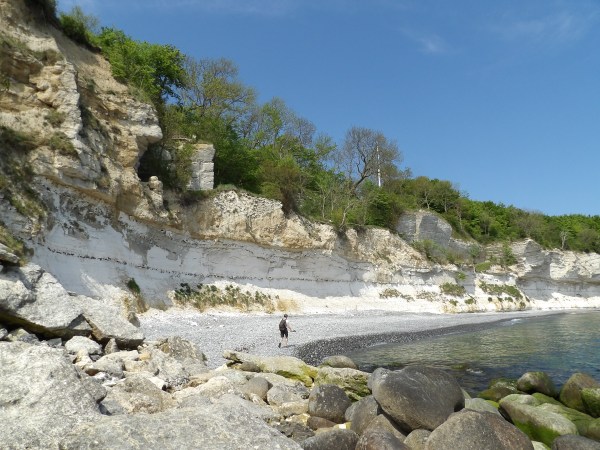
Located on the eastern coast of Zealand, Stevns Klint is a stunning 15-kilometer-long white chalk cliff that doesn’t just offer breathtaking views, but holds a story that changed the history of life on Earth. Recognized as a UNESCO World Heritage Site, this cliff is one of the most scientifically important locations in the world for understanding the mass extinction that wiped out the dinosaurs.
Where dinosaurs met their end
What makes Stevns Klint so unique is a thin, dark layer of clay found within its layers of chalk and limestone. Known as the “fish clay”, this band is rich in iridium, a rare element more commonly found in asteroids than on Earth. This thin layer marks the Cretaceous-Paleogene (K-Pg) boundary, about 66 million years ago, and provides compelling evidence that a giant asteroid struck Earth – the same event believed to have triggered the extinction of nearly 75% of all species, including the non-avian dinosaurs.
The chalky cliffs at Stevns Klint
As you can imagine, the cliff is a paradise for geologists and paleontologists. My flat-mate, also a geologist was ecstatic. Before moving to Denmark he worked as a paleontologist on a research project in Romania. This was right up his alley.
The fish clay-extinction band running along the side of the cliff
Fossils preserved in the chalk layers above and below the iridium-rich boundary reveal a vivid picture of life before and after the impact. Tiny marine organisms like foraminifera show a sharp decline right at the boundary, offering one of the clearest extinction markers in the world. Scientists continue to study Stevns Klint to understand not only how life vanished but also how it rebounded in the aftermath.
Bonus modern attractions
Surprisingly enough, Stevns Klint isn’t just about ancient history. The geological features of the cliff weren’t news to me, but as we discovered the area also had stories from more recent times. Perched dramatically at the cliff’s edge is Højerup Church, a medieval church built around 1250. At the time located safely inland, but over the centuries inching ever closer to the edge due to relentless erosion of the cliff.
Højerup Church
For generations, the local legend warned that the cliff was retreating, inch by inch. In fact, there’s a Danish saying: “The church moves one cock-step closer to the sea every Christmas Eve.” While poetic, that warning became very real on March 16, 1928, when a large section of the cliff collapsed, taking the entire eastern part of the structure with it. Immediately decommissioned for religious services, the locals rallied to preserve what remained of the church.
The back of Højerup Church inching towards the sea
Beneath the cliffs, hidden in the limestone, is another surprise attraction. Namely the Stevnsfort Cold War Museum, a once-secret fortress built to withstand nuclear attacks during the Cold War.
Stevnsfort
Built in 1953, at the height of Cold War tensions, Stevnsfort was part of NATO’s front line defense. Its strategic location on the coast of Zealand gave it a commanding view over the Øresund Strait, a crucial naval passage between the Baltic Sea and the North Sea. The fortress was designed to help detect and, if necessary, halt Soviet warships attempting to reach Western Europe.
Rocket artillery pieces on display in the museum courtyard
For decades, the site was fully operational and highly classified. It wasn’t until the early 2000’s that the base was officially decommissioned and turned into a museum. Even as a museum it’s so hidden from sight that we didn’t notice it until we were leaving Stevns Klint. Only then did the huge tank and rocket artillery on display in the courtyard catch my eye, spurring me to investigate.
Nothing like posing with the Centurion MBT in your cycling gear…
Unfortunately though, it was fairly late in the afternoon and we wouldn’t have had time for a proper visit before closing time. That’s one attraction I regret never taking the time to go back to while still living in Denmark.
Day trip to Sweden
A couple of months later, my friends and I were preparing for another excursion. I don’t recall how and why we decided on this, but we were basically going to visit Malmö in Sweden for half a day.
Located just across the Øresund strait from Copenhagen, Malmö is the third largest city on Sweden and the largest city in the southernmost province of Skåne. The two cities are linked by one of Europe’s most impressive feats of engineering, the Øresund bridge.
The Øresund bridge on a muggy morning, seen from the Danish side
Opened in 2000, this impressive structure not only connected the two Nordic cities, but also formed a vital artery between Scandinavia and the rest of Europe. Spanning approximately 16 kilometers in total, the crossing combines a 7.8 km cable-stayed bridge with a 4 km underwater tunnel, joined in the middle by an artificial island named Peberholm. Accommodating both a 4-lane motorway and a dual-track railway, the bridge has become a cultural icon, famously featured in Nordic noir television and admired for its sleek design and ambitious scale.
The Øresundståg train, was the most convenient option for us. You can board it at several stations on the Danish side, including Copenhagen Central, Nørreport, Østerport stations, as well as Kastrup at Copenhagen Airport. The ride lasted about 40 minutes from downtown Copenhagen. Before we knew it we were already in Sweden.
Malmö
Once an industrial port town, Malmö has undergone a drastic transformation into a modern, eco-conscious city. So much so that it has taken the top on the list of Europe’s greenest cities.
Walking around Malmö
One of the most striking symbols of Malmö’s reinvention is the Turning Torso, a twisting skyscraper designed by Santiago Calatrava, which towers over the city’s redeveloped Western Harbour (Västra Hamnen). This area, once a shipyard, is now a model for sustainable urban living, featuring energy-efficient buildings, green spaces, and a popular seaside promenade.
The Turning Torso skyscraper in Malmö
Close encounter of the green kind
Malmö is also known for its strong tradition of activism and social engagement. It has long been a politically progressive city, often leaning left in Sweden’s political spectrum. It has a history of grassroots organizing and is home to numerous NGOs, cultural centers, and activist groups advocating for equality, justice, and environmental sustainability. I bring this up because even during our short visit we ran across activists engaging with people on the streets.
Dude just casually kite surfing the canals in Malmö
In our case, it was a vocal group advocating for veganism to combat animal cruelty and industrial farming through reduction of meat consumption. As much as we sympathized with the cause, we were not really the right target audience for their campaign, as at least at the time, we were all uncompromising meat-eaters. This lead to a few snarky remarks and “troll-face” exchanges, which the activists were not pleased with.
We weren’t there to please them, of course, just to explore and have a bit of fun, even if it meant rolling our eyes at a few preachy, virtue-signaling activists parading their self-fed moral superiority for all to admire.
Old town
Despite its modernity, Malmö still honors its historical roots. The medieval Stortorget and Lilla Torg squares are nestled among charming cobblestone streets in the old town, while landmarks like St. Peter’s Church offer a glimpse into the city’s rich past.
Statue of Karl X Gustav in Stortorget
The architecture in this area showcases the city’s rich history, with a blend of Renaissance, Baroque, and Neo-Gothic styles, similar to Copenhagen’s historic center. The nearby Malmöhus Castle, a Renaissance fortress now housing museums and exhibitions, stands as a testament to centuries of regional history.
Ready to go home after a day of exploring Malmö
After walking around the harbor and central areas for a few hours, we plopped down in the city’s main square and soaked in the afternoon sun. With a pleasant day of city-exploring behind us, we were ready to head back to the train station and Copenhagen.
During late November, 2017, while I was routinely scrolling through my Facebook feed, a random ad post caught my eye. It was from DFDS, a Danish international shipping and logistics company, and read something like “The cheapest ferry ride ever”, roundtrip from Copenhagen to Oslo.
With a raised eyebrow, and high skepticism I decided to check it out on their website and, it was indeed legit. Copenhagen to Oslo, round trip on selected dates within the next couple of weeks for 2 DKK… I repeat, TWO KRONER… That’s less than a dollar!
Full moon spontaneity
This was one of those rare opportunities for a spontaneous adventure that I couldn’t pass up. However, I hoped to get at least one of my friends on board to go with. This wasn’t the easiest thing to do as most of my friends were working at the time and couldn’t, or wouldn’t just want to suddenly take time off. Having recently graduated, I had the “luxury” of still being unemployed. Luckily, there was at least one other person I could think of in a similar boat.
None other than Eddy, my Nigerian colleague and close friend from KU who had also recently graduated and was job-searching. I quickly reached out to him with a proposal to take a break from the mundane and to join me on the cheapest ferry ride ever.
Setting sail
Within a week or so, Eddy and I were ready to embark on our dirt cheap journey to Norway. The ferry departs daily at 16:40 from Copenhagen and arrives in Oslo the next morning at around 10:00. It stays in port until around the same time in the afternoon before returning to Copenhagen. To keep to the theme of cheapest trip ever, both of us made sure to pack enough sandwiches to last us through the outbound journey.
Nordhavn, Copenhagen, before departure
Once on board, we left our things in our cabin in the bowels of the ship and rushed up and out onto the deck to enjoy the view; and what a view it was… Since it was around early December, it was already nightfall by the time we were supposed to leave. Copenhagen’s lights glimmered and shined against the fading hues of the late sunset, their reflections dancing over the dark, rippling waters.
Not long after, the ship began to slowly drift away from the shore. As we floated away, the bay of Nordhavn offered some excellent photo opportunities that I couldn’t pass up. The downside was that the chilly wind and ship’s movements made it hard to get a clean shot since my camera didn’t have stabilizer.
Eddy and I, ready to set sail
After leaving Copenhagen behind, we returned to our rooms to warm up and rest. This was my first time traveling on a big ship and I was curious if and how the rocking motion would affect me. For the first hours of the trip we could barely feel any movement. Eddy fell asleep and I sat in my bed reading and doom-scrolling through my phone.
The Kattegat sea
A couple of hours into our trip, the rocking had begun. It was very subtle at first, especially while laying in bed, but I noticed that I’d constantly have to reposition myself as I kept sliding off the bed. The novelty of this excited me and I immediately got up to go topside.
Old photos of ferry ships of the DFDS fleet on display
We had now left the calm waters of the Øresund strait and were sailing into the much more turbulent Kattegat sea. As I walked towards the deck, the rocking was way more prevalent. It wasn’t bad by any means, but it felt and looked as if everyone on the ship was a bit drunk. Once I got out, I was instantly hit by rushing cold winds and water droplets from the waves smashing into the side of the hull.
It felt bad enough that I didn’t want to get anywhere near the handrails. Instead, I kept close to the walls and enjoyed the raw elements battering our ship in the night from a safe distance. I was also pleasantly relieved that I didn’t feel any motion sickness. In fact the entire night trip was quite pleasant and I think all that rocking even helped put me to sleep faster.
Arriving in Oslo
When we got up the next morning, we finished our sandwiches and rushed back up onto the deck to be greeted by the sights of the Oslofjord.
Sailing through the Oslofjord
Sailing past residential and industrial buildings scattered across the surrounding hills, our ship slowly but surely made its way along the fjord and into the port of Oslo. As we turned to dock, one building in particular stuck out with its bold, modern, angular shape. Namely the Oslo Opera House, situated in Oslo harbor.
Oslo Opera House looking like an iceberg
After disembarking, Eddy and I wandered off into the busy streets of the city for a day of sightseeing.
Oslo
Arriving in Oslo feels like stepping into a city that balances its rich past with a crisp, modern energy. The Norwegian capital, founded over a thousand years ago during the Viking Age, has grown from a medieval trading post into a vibrant waterfront city. Walking along the harbor at Aker Brygge, you can see sleek new buildings standing beside old wooden piers, where merchant ships once unloaded goods from across Europe.
Oslo harbor from the ship’s deck
Heading inland, we followed the wide, clean streets past the striking Oslo City Hall, a huge red-brick building famous for hosting the Nobel Peace Prize ceremony. Its twin towers loom above the harbor, decorated with murals and carvings that tell stories of Norway’s seafaring and working-class roots. From there, the city begins to open up.
Oslo City Hall (Rådhus)
Crossing into the city center, we passed through the People’s Theater (Folketeateret), an art deco building that once hosted grand operas and plays, and today holds concerts and modern performances under its stately old signage.
Folketeatret, also home to a weird sculpture of Kate Moss in a yoga position, among other things
As we continued along some of the side streets, we came across this amusing giraffe mural on one of the buildings, its long neck and goofy-looking face resembling ET the extraterrestrial.
ET the giraffe
After about an hour of strolling through the streets, we arrived at the The Royal Palace (Det kongelige slott), located at the end of Karl Johans gate, the main boulevard of the city. Built between 1824 and 1848, the palace is the official residence of the Norwegian monarch.
Ain’t nothing like being back in Norway!
Standing as a historic landmark, the royal residence was originally built for King Charles III John, the first king of Norway after the country gained independence from Denmark.
Jul i Vinterland
Heading back from The Royal Palace, we passed by the central part of the University of Oslo’s historic campus and the Norwegian parliament building. It was around noon, so we were on the lookout for a cheap place to grab a bite. Not something easy to find in the center of Oslo.
University of Oslo building in the city center
As we strolled along Karl Johans gate, we came across “Jul i Vinterland”, Oslo’s largest and most iconic Christmas market. Located in Spikersuppa, a city square between the National Theatre and the Royal Palace, the enchanting market transforms the heart of the city into a festive wonderland each winter.
Oslo’s Christmas market
At the center of the market was an open-air ice skating rink, free for all to enjoy. Surrounded by twinkling lights and festive music, it provided a perfect setting for skating enthusiasts and families alike. Various amusement rides dotted the square, including a 40-meter-high Ferris wheel providing panoramic views of the city.
Food and drink stalls at Jul i Vinterland
All across the square bustling stalls offered a variety of gifts, clothing, toys, and culinary delights. We couldn’t pass up the chance to enjoy a cup of gløgg (mulled wine) while we were there.
Nothing like a cup of gløgg on a cold December day
As we stood there in the cool outdoors enjoying our hot beverage, the first snowflakes of the season started coming down, marking the start of winter. Even if it barely lasted a few minutes, it was just such a perfectly hygge moment… Being back in Norway and enjoying a hot drink in a festive atmosphere with one of my dearest friends while witnessing the first snowfall of the end of 2017.
Oslo harbor and heading back home
After leaving the market, we found a reasonably priced place to have a quick lunch and then made our way back to the harbor. We strolled around there for another hour, or two until it was time to head back to the ferry.
The Diver (Dykkaren) located along the harbor promenade
This was now my third time visiting Norway and thus far each of my visits had these memorable “feel good” moments that I will never forget. Be it the peaceful solitude of the lonely mountain high above the fjords in Borgund, the vivid sunset reddening the sky in Jostedalsbreen National Park, or the first snowfall at Oslo’s cozy Christmas market.
There was definitely something special about this country for me. Something that kept calling me back. Whether this would lead to a more permanent move there in the future was anyone’s guess. For the moment, it was time to head back home to Denmark.
Adios Oslo. Until next time!
That night on the ferry, Eddy and I decided to dine out on the ship. Even if a bit pricey, after this incredibly cheap little holiday we felt we deserved a little indulging. Plus, this was my way poor-man’s way of paying back DFDS for this awesome opportunity that basically cost nothing.
A delicious steak and beer dinner on the ferry
While enjoying our steaks and fancy beers, I kept thinking of if and when will the day come that an experience like dining out on a ship won’t feel like indulging in a once in a lifetime financial expense. Will there ever be a time when I can just enjoy things without constantly looking at the costs? Maybe… Hopefully.
Hoisting up the Danish flag. We’re coming home!
The next morning, while we were back sailing in the calm Øresund strait towards Copenhagen, I was out on the deck looking out at the horizon, wondering what the future holds. Even with all the ups and downs of life, and constant financial difficulties, as long as the good stories and adventures kept flowing, life was pretty darn good and worthwhile.
Following my two-weeks adventure in Iceland in August 2016, I returned to Denmark. However, it wasn’t for long as I was planning another little trip. This time non-work related. During the time I had moved and settled in Denmark, one of my best friends from back in Romania, Daniel, had decided to move to Norway. The promised land, the land of an unforgettable adventure that started it all for both of us. Now that I was financially stable and settled into my new life, it was time to return to the far north and reunite the brotherhood!
Thus just a few weeks after my return from Iceland, I took a flight from Copenhagen to Trondheim to visit my best buddy in Norway.
Once more above the clouds
Back in Norway
I got to Trondheim pretty late at night. By the time Daniel picked me up and we got back to his place his then girlfriend was sleeping. As was most of the neighborhood. I remember we sat out on the porch during the cool Norwegian night drinking and chatting away while trying to keep our voices down.
We had a lot to catch up on since both of our lives had radically changed since last we met. However, no matter how much had changed, how much we’d change, we would always seamlessly pick up right where we left off.
After one and a half year, the Brotherhood reunites!
The next day was a Friday and Daniel had planned a little road trip for us over the weekend. After a lazy morning, he had to run some errands in the city so I tagged along and got my first brief view of Trondheim.
Driving around Trondheim, Norway
Around noon we drove over to the one of the University of Trondheim locations to pick up his girlfriend. As I was waiting, I remember admiring this casually parked submarine in the harbor right next to the building.
This is not the yellow submarine
Soon enough, we were all packed up and ready to hit the road for the weekend.
Jostedalsbreen National Park
For the rest of the day and well into the night we drove to the Jostedalsbreen National Park, mainland Europe’s largest glacier. We couldn’t see much of anything during our night drive, but the next morning we were treated to quite a spectacular view.
A cool, misty morning in Jostedalsbreen National Park
We woke up in the heart of the national park, somewhere in, or near Fjærland. It was like poetic justice that we started off our trip in the place that we were eyeing three years before, from across the fjords and mountains in Søgndal. I have to admit though, for the better part of this trip, I had no idea where we were. I was just marveling at our surroundings and enjoying the adventure.
Norwegian Glacier Museum in Fjærland
Our first stop of the day was the Norwegian Glacier Museum in Fjærland. The museum showcases the science of glaciology, the history of glaciers in Norway, and their role in climate change. It featured interactive exhibits, models, and presentations on the topic.
Glacier model at the Norwegian Glacier Museum
The museum also highlights the cultural significance of glaciers in Norway’s history and provides insight into the challenges and importance of preserving these natural wonders. But best of all, the museum had a big polar bear in the lobby area that I could high five!
Heck yeah!
Melkevoll Bretun
Following a scenic drive around and under the mountains, we ended up on the northern side of the glacier, at Melkevoll Bretun. Located near the Briksdal Glacier (Briksdalsbreen) in Stryn, Melkevoll Bretun offers stunning views of dramatic glacial landscapes. It was time for a little hike.
The trail to Briksdalsbreen glacial lake
A 3 km trail from Briksdal Mountain Lodge led all the way up to the Briksdalsbreen glacial lake. The winding gravel trail took us up the mountain through lush valleys surrounded by towering peaks and cascading waterfalls. On our way up we passed Kleivafossen waterfall, one of the major highlights of the the hike.
Kleivafossen waterfall spraying everyone that passed it by
Following the waterfall we passed by some cool glacial features in the outcropping rocks. Jettegryter, or the giant potholes formed naturally during the last Ice Age, when glacial meltwater carried rocks and debris that swirled in strong currents, grinding into the bedrock.
The giant potholes (Jettegryter) on the Briksdalsbreen trail
The polished, smooth wall of the rocks also revealed other neat features in these rocks that would excite any geology enthusiast.
Structural features in the rock layers, including displacement and boudinage
Of course a Norwegian hike wouldn’t be complete without encountering a pack of goats. Most of them were minding their own business, grazing around. But then there was this one goat perched up on a rock that was just staring down at us lowly humans like the king that he was.
Close encounter with the Goat King
Briksdalsbreen
Shortly after our encounter with the Goat King, we reached Briksdalsbreen glacial lake. A serene lake with a gorgeous view, Briksdalsbreen glacial lake continues to grow larger as the glacier gradually retreats over the decades.
Briksdalsbreen, an arm of the larger Jostedalsbreen ice cap
This was one of the best places to test out my newly acquired PENTAX digital camera. It wasn’t as fancy as a Canon, or Nikon, but its fixed lens had quite an impressive zoom for the time. The only problem was keeping the camera steady. I never invested in a tripod, so I had to always find just the right surface around to get my zoomed in shots.
Briksdalsbreen zoomed in
I ended up getting some really neat zoomed in shots of the glacier. One of them even captured distinctive cracks/crevasses in the blue ice.
Even more zoomed in action revealing cracks in the ice
Of course I couldn’t just ignore the jagged mountain peaks surrounding us. After a quick camera repositioning, I got some moody shots of the landscape as well.
Ice patches tucked away between the surrounding mountain ridges
Finally, Daniel ended up just in the right spot for a spaghetti western style shot!
The man, the viking, the legend, Dovahkiin Daniel
An epic sunset
After we finished our nature photoshoot at Briksdalsbreen, we slowly headed back to the parking lot. As we drove back towards our lodging, the clouds led up just enough to offer some amazing sunset views that just kept on getting better and better.
Sunlight just barely grazing the peaks of the mountains
Even Daniel was constantly staring into his mirrors while driving while we were “oo-ing” and “aa-ing” at the scenery. We ended up pulling over numerous times to get the best shots.
Jostedalsbreen in the distance
But it wasn’t until the apex of the setting sun that we were truly treated to some spectacular sights.
An epic Norwegian sunset
Nothing like a lake view of the burning red sky as the sun goes down behind the mountains and fjords. A perfect way to end a great day on the road. However, our adventures in Norway were not over yet. The story will continue in “The return to Norway part 2”.
The three things you wouldn’t normally expect to hear in the same sentence are warm, sunny, Iceland. Yet this pretty much sums up the entirety of our two week field trip to the north Atlantic island.
Just to briefly recap: my whole going to Iceland actually started with a late-2015 proposition from my soon to be MSc thesis supervisor, Paul Martin Holm, to do a project on Argentina. Then after the Argentina project ended up being a bust due to some financial miscalculations, Paul Martin was quick to offer me another possibility: the Iceland project.
Grass-covered basalt layers and volcanic edifices – a taste of what is to come
Thus, I was fortunate enough that in early August 2016, I was flying together with Paul Martin, on an all expense covered field trip to Iceland. As it turned out, that August would be one of the sunniest and warmest periods Iceland had had in quite some time. Fortune was truly in our favor!
Airport shenanigans
As I was on the metro heading towards the airport on the day of our trip, I suddenly got this nose bleed out of nowhere. Alright, no big deal. I thought, it should stop by the time I actually got the airport. Nope! It kept on going, no matter how much tissue paper I stuffed up in there. I don’t know if it was stress, or what, but this was really out of the ordinary for me…
Some time later, I meet up with Paul Martin in the airport. He’s there all cheerful and happy and here I come leaking blood all over the place. He started asking if I was alright, if I was good for the trip. I was more annoyed than anything else because I couldn’t stop the nostril faucet and enjoy our upcoming trip. Too much excitement?
Oh, and someone had lost their balloon in Kastrup Airport… Tragic!
So we end up talking to airport staff who connects us to a medical person they had on the line. We ask the person on the line weather it’s safe for me to get on the plane with my stupid nose bleed. The person gave me the all clear and finally, by the time we get to security, the bloody leaking stopped. We were off to a “fantastic” start, I said to Paul Martin…
Arrival
Luckily the flight was fairly uneventful and once we were above Iceland we got to have a decent areal view of the fantastic landscape below.
Flying above the volcanic chains of Iceland for the first time in 2016
As I recall we spent quite some time at either, or both the airport and the car rental agency. There was all sort of paperwork for Paul to fill out and waiting around for other people.
One thing with Iceland is that they are, or were, very rigorous about what goes out of the country. Especially when it comes to rocks. The country doesn’t want tourists to be taking rocks from their National Parks away as souvenirs. Since we were on a geological research project and it was kind of our business to take rocks away, there were all sorts of forms to sign and people to notify.
Then the car rental people were slow with delivering our car. Just as a heads up, Iceland is an extremely expensive country and renting cars is no exception. So Paul went with the cheapest agency he could find that rented out SUV’s. Finally, after a few hours, we had our Toyota Landcruiser and were heading to our hotel in Reykjavik.
Exploring Reykjavik
I had the rest of the afternoon off and was planning to meet up with my Icelandic friend Bjørn from Denmark, who was back home in Reykjavik.
Beautiful, Sunny Reykjavik
The weather was fantastic. Slightly breezy, but sunny and warm. Nothing like what Bjørn had described to me with his doom and gloom build-up to my trip. The moment I meet up with him he was upset. He was angrily exclaiming that this isn’t fair! I’m not seeing the real Iceland. It’s supposed to be cold, rainy and super windy, always! Well… Not when I’m there, I said to him laughing out loud.
Bjørn then took me around the main attractions of central Reykjavik. We started off with the iconic Hallgrimskirkja, a towering 74.5 m high church that stands as one of the tallest structures in the country. It’s unique exterior design resembles that of columnar basalts found in various parts of the country, as well as other volcanic regions around the world. In front of the church is a statue of Leif Eriksson, the famous Viking explorer thought to have been the first European to reach North America.
Hallgrimskirkja with the statue of Leif Eriksson in the front
Harbor area
From Hallgrimskirkja we walked around the small center briefly touring the University of Iceland’s campus. Afterwards we headed towards the Harpa Concert Hall and the harbor area. Here ran across Minør, a small preserved steam locomotive. Part of the short-lived Icelandic narrow-gauge railway, it was used in the early 20th century in constructing the Reykjavik harbor.
Minør the steam locomotive
Finally, we went over to Bjørn’s place, which was close to the harbor. Everything just seemed close in Reykjavik, one of the smallest and neatest capitals in the world. After meeting part of Bjørn’s family, we headed up to a rooftop terrace where a splendid city view welcomed us. We proceeded to enjoy a couple of cool drinks and soak in the warm rays of sunny Iceland.
Having a beer with Bjørn in Reykjavik
From student to colleague
In the evening, I met up with Paul Martin and we went out to a restaurant of his choosing to have dinner. This would be one of the last day we had a high quality cooked meal, as for the next two weeks we’d be traveling across Iceland and eating mostly canned foods and sandwiches.
Paul asked me if I’d like to share a bottle of wine with him. Seeing the extravagant prices around me, I sheepishly replied that I would, but considering the rule we had in our Gran Canaria field trip that students pay for their alcohol, I was reluctant to pay the hefty sum out of my barely recovering pockets. The man smiled and replied, but you are not a student here anymore, you are my colleague, so that rule doesn’t apply. I loved this guy! He always knew how to brighten my mood. We continued on to have a wonderful dinner with drinks and jolly banter.
The next morning, we packed up the Landcruiser and drove all day north to Akureyri.
The long drive north to Akureyri and the start of our Iceland adventure
The months following the decision to move to Denmark were filled with elation and renewed excitement. Finally, after what felt like a lifetime of failed attempts, I was going to leave my birth country behind for good. It was now time to go out there and find my place in the world. A place I could one day call home.
The final north-Transylvanian adventure
During the spring of my last year in Romania, my good buddy Daniel and I planned a little road trip across Maramureș County. He and his girlfriend at the time came over to visit a couple of monasteries and take a steam train ride along the Vaser Valley. For me, going on one last Transylvanian adventure with my best friend was a fitting way to part ways with my past.
The trip took a little over two hours by car from my hometown of Baia Mare. On the way we made a stop in the town of Săpânța to visit the Merry Cemetery (Cimitirul Vesel), famous for its brightly colored tombstones with paintings and poetic descriptions of the past lives of its residents.
A sea of color at the Merry Cemetery, Săpânța (2015)
Northeastern Maramureș
Late in the afternoon, we arrived at Vișeu de Sus where we would spend the night in the Mocănița train yard. The train yard has multiple parked train cars with sleeping compartments. These compartments are rented out to visitors staying the night and have all the necessary amenities of a hotel room.
The over-night train cars in the the Mocăniță train yard
There are several picnic tables next to the train cars to enjoy an outdoor evening dinner and breakfast. There’s also a couple of old refurbished locomotives on display that you can view and explore.
Big old steam-powered locomotive on display
The next day we briefly visited the Bârsana Monastery to the south. Home to the tallest wooden church in Romania, Bârsana Monastery is situated in the centuries old settlement of Bârsana, dating back to the 1300’s.
Bârsana Monastery, 2015
The outside courtyard has many walkways across the Monetary gardens and boasts a couple of beautiful peacocks. The wooden buildings are decorated with wooden carvings and religious iconography.
Peacock at Bârsana Monastery
In the afternoon, Daniel and I took a little road trip to the city of Borșa situated at the foothills of the Rodna Mountains. As we saw the mighty snow capped mountain peaks in the distance, we felt them calling to us. Teasing us, daring us to attempt a little adventurous hike. We couldn’t refuse, however, after a short half an hour walk up the slope, a wet chilly breeze coming down from the mountain reminded us of our past reckless experience in the Făgărăș Mountains. So we decided to play it safe this time around and returned to the safety and comfort of our train yard in Vișeu de Sus.
Mocănița
The following morning our little steam powered train was all ready to take us up the Vaser Valley.
Grumpy morning face
Mocănița, which roughly translates to the little shepherd is a narrow-gauge railway built around the mid 1930’s. The railway is serviced by several steam engines two of which were built in Germany in the early 1900’s.
Chugging along
Partially destroyed during World War II, the railway was later rebuilt and mainly used for logging until 2004 when work began on turning it into a tourist attraction. The 47 km main line runs from Vișeu de Sus to Comanu near the border with Ukraine. However, the service usually terminates at Faina station due to ongoing rehabilitation work on the line.
Our steam powered locomotive
The train made a few stops on the way for fueling, or repositioning. The trip took a few hours both ways and crossed the exceptionally scenic Vaser Valley home to a variety of wildlife, including brown bears and deer.
Along the Vaser Valley
As the trip progressed, the valley became increasingly narrower, with the rolling hills turning into steep mountain cliffs flanking both sides of the track.
She’s getting pretty tight
Around noon, we arrived at Faina station in the heart of the Maramureș Mountains Natural Park. After having a quick snack, we spent the afternoon roaming around the gorgeous landscape before heading back to Vișeu de Sus in the evening.
In the heart of the Maramureș Mountains Natural Park
We spent the final night drinking and laughing, reminiscing and goofing around the train yard. I couldn’t have asked for a nicer farewell and ending to this first big chapter of my life.
Beyond the threshold
As my departure date came close, I recall a now familiar feeling I then felt for the first time. It’s hard to describe this feeling, but to me it’s like a “life threshold”, a point beyond which you can’t see anymore.
Perhaps it was the fairly repetitive nature of my life up to that point that made things fairly predictable. Being in the same places around the same kind of people, there’s always a type of familiarity in your life. I always yearned for more. To explore new places, meet different kind of people and experience new things. This is why I loved traveling so much, especially aboard, since this opened up a whole new world for me. Even so, as exciting and memorable as each of my travels was, they were just that. Short episodes in an ocean of fairly mundane, predictable days and weeks.
However, this time it wouldn’t be a short episode. It would be a complete overhaul of my day to day life. Everything would change. I simply could not imagine what my future looked like after moving away from Romania. I couldn’t see beyond the threshold, but I had a gut feeling that it’ll all be ok. Thus, there was no fear, no anxiety, just a calming inner peace and a trust in myself that I’ll figure it out. I was ready to embark on a new journey and begin my Odyssey from East to West.
One final look back before departing on the train of life in search of a new home
The journey from Fagernes towards the west-fjords remains one of the most impressive bus-rides for me to date. The way in which the mountain range grew and grew, with steeper and ever more imposing cliffs presented some of the most breathtaking views I’ve seen. As a mountain lover I just had to hike up on one of those beauties!
The rising mountain ranges along the road from Fagernes, to Sogndal, Norway
If memory serves, we still didn’t have an exact destination in mind. All Daniel and I knew was we wanted to reach the sea water coming in through the fjords. Although, there were a few spots with a bus stop where I fantasized about getting off and just start hiking. There was this beautiful little spot, in the middle of nowhere, well within the Jotunheim mountain range. The only sign of civilization were a couple of houses by a lake, with gorgeous valleys and mountains behind. We talked about potentially stopping there for a day on our way back. However, we weren’t sure if the bus would always stop, or we’d end up stuck there. Ah, who would want to leave there anyway!
Picturesque view from the road somewhere around Tyinkrysset, Norway.
Crossing the fjords
Well within the mountains now, the valleys following small rivers became ever narrower. The cliffs flanking the road seemed to engulf us on all sides. The bus came to a stop for about half an hour, or more in a small town in Årdal. The town was situated by the water, with the most imposing mountain cliffs surrounding it. The instant I walked out of the bus, my fear of heights/tall things kicked in. I felt like I was in a big bucket, with the gigantic rock facades ready to collapse on top of me. As beautiful and impressive as it was, I think I just quickly took a couple of pictures and went back into the bus due to my anxiety. It is quite an annoying phobia that I still sometimes struggle with to this day.
A brief stop in Årdal, Norway
It was in Årdal where got our first taste of the mighty fjords. The small river now opened up into a huge body of flowing water, carving its way through the deep valley. Soon after, our bus climbed on to a large ferry. This was the end of the road. The only way forward from here was by boat!
Crossing the fjords by ferry from Årdal to Sogndal
Sogndal
After the 10-15 minutes ferry ride, we were back on the road and close to what became our final destination in west-Norway. I don’t recall if we had planned ahead, or it was another one of those spontaneous decisions, but Sogndal was as far as we would go. Specifically the village of Sogndalsfjøra nestled in the heart of the Sognefjord. We found yet another camping ground and settled in for two days of hiking and exploring.
Sogndalsfjøra, Norway
Our stay in Sogndal was fraught with adventure: deadly spiders, breathtaking vistas, polish people, mushrooms and more! I will elaborate in my next post of this series.