Late summer 2019. I was back in Copenhagen, Denmark — one final time.
Even writing that sentence hurts a little. Emotional soundtrack playing in the background, naturally. But jokes aside, this was it. After the most adventurous summer of my life, crossing Europe one last time, I returned to the city that had been my home for four years. Only for a couple of weeks. Just long enough to say goodbye.
Goodbye to friends. Goodbye to routines. Goodbye to a country that had shaped me far more than I ever expected.
The old pavilion by the castle lake at Frederiksborg Castle, Hillerød
Denmark is often described as cold — its people reserved, distant, hard to befriend. I found that to be mostly myth. What I encountered instead were warm, straightforward, quietly kind people who opened doors for a foreigner trying to find his footing. As I packed my final bags and counted down the days to my flight to Canada, I realized something painful and beautiful at the same time:
My farewells had begun long before August.
The Last Ride North
In truth, the goodbye started in early June. That’s when I took my final cycling trip north to Hillerød — a route I had ridden many times before, but one that felt different this time. The sun was high, gifting Denmark one of those rare, perfect summer days when everything feels briefly aligned.
Just a satyr splashing in the fountain
The ride began in Amager, cutting through Copenhagen’s city centre and past the familiar lakes of Brønshøj. Then came the long stretch along the forests hugging the lakes near Farum — another place I once called home — before the rolling hills of North Zealand took over. Small towns passed quietly. Forests closed in again. And finally, Hillerød.
Frederiksborg Castle, Hillerød
Jesper and I walked around the castle grounds as we had done before, talking about life, work, and whatever lay ahead. We wished each other the best — sincerely, without ceremony. I sometimes wonder if he stayed there, if he settled down, started a family like so many of my friends did, while I kept drifting across borders and oceans.
That ride felt like closing a circle.
Copenhell: Noise, Sweat, and Catharsis
Early summer held another goodbye I hadn’t yet written about.
After Wacken Open Air in 2018, 2019 brought something closer to home: Copenhell, Denmark’s largest metal festival — and its 10-year anniversary. A very different experience this time. No tent. No mud. I cycled in and out daily from my apartment in Amager, the festival grounds conveniently close.
Copenhell 2019 festival grounds
Two concerts stood above all others.
Slipknot
Slipknot was chaos in its purest form.
I forced my way to roughly the tenth row before the show began. The black curtain loomed above us, the band’s name stamped across it. Distorted noise filled the air — the intro track 515 from Iowa. The crowd screamed, compressed, surged. Then the drums hit.
I will never forget that insane intro to this concert
The curtain didn’t fall — it twisted upward violently, like it was being sucked into a vacuum, revealing the band already blasting at full force. The crowd exploded. I felt an insane pressure as bodies crushed forward. For a moment I thought I might lose my phone — or my breath. Then it clicked.
Slipknot it all of it’s glory, with big Mick Thomson in the center — Corey Taylor and Shawn Crahan flanking him
I was at a Slipknot concert. So I shoved back, found space, and gave in completely — screaming, jumping, laughing like my teenage self had been waiting years for this moment. Somehow, through the chaos, I ended up even closer to the stage.
Later, during Duality, I crowd-surfed for the first time in my life. Absolutely wild. Unforgettable.
Dimmu Borgir
Dimmu Borgir was something else entirely.
I claimed a front-row spot early and waited patiently, barely drinking so I wouldn’t lose my place. Worth every second. The atmosphere was darker, ritualistic, less primal but more intense in its own way.
Shagrath posing with the ram head in his ritualistic robes
During one of my favorite songs, I let out a loud long war cry — something that still makes me laugh when I think about it. I was finally seeing one of my all-time favorite bands, these legendary Norwegian musicians I’d admired for years.
Galder and Silenoz shredding hard during their concert
As the crowd dispersed afterward, I lingered near the stage. One of the crew walked by and handed me a guitar pick. A real Dimmu Borgir pick. I still cherish it to this day.
Winds of Change
On the final night, The Scorpions took the stage.
That’s when I met up with my old friend Lasse — drunk, hoarse, and gloriously exhausted. We sat on a small hill overlooking the massive crowd as the opening whistles of Winds of Change began.
The Danish flag shown proudly during the Scorpions concert
We whistled along. Then sang — badly, loudly, sincerely.
Candles lit up across the crowd as darkness fell. My voice was nearly gone. So was his. That moment — the song, the crowd, my friend beside me — felt like the perfect, unspoken farewell.
One Last Dinner
By August, it was time for quieter goodbyes.
My roommates and I planned one final group dinner with our computer scientist friends, and I suggested Folkehuset Absalon. I’d been introduced to the former church years earlier — repurposed into a community space filled with shared meals, conversations, and long wooden tables.
Every evening at six, strangers and acquaintances alike gathered for communal dinner — delicious, home-style food served family-style. Affordable, warm, human. It felt right.
The Machine and friends after our last dinner together in Copenhagen
Sitting there one last time, sharing food and stories, I realized how deeply Denmark had taught me the value of community — not loud or forced, but quietly present if you chose to participate.
What Denmark Taught Me
When I arrived in Denmark years earlier, my only real goal was to leave Romania.
To escape. To prove myself. To breathe.
I believe I did that. During my Master’s at Copenhagen University, I started behind my peers and ended up exceeding expectations. I learned discipline, independence, resilience. I even began dreaming of academia. But I also learned something harder: effort alone isn’t always enough.
One last evening stroll along the streets of Copenhagen
Financial instability followed me for years. Career opportunities came slowly. As much as I loved Denmark, there was no future for me there along my chosen path. So my thinking changed.
Idealism gave way to pragmatism. Stability, income, and long-term opportunity began to matter more than prestige. That shift shaped my decision to choose Canada over Switzerland, industry over academia, practicality over purity. It shaped my growing interest in investing, markets, and long-term independence.
The Next Chapter
If my Danish saga was about escape — about searching for an idealized happiness — then my Canadian saga would be about ambition.
The day I embarked on the next big adventure of my life
With my final bags packed and every goodbye said, I boarded the transatlantic flight that carried me away from Europe and toward an entire new chapter filled with its own radical ups and downs.
As my Danish Saga came to a close, my Canadian chapter was about to begin.
January 2019—I was still living in Farum, Denmark—still unemployed, and feeling the mounting pressure to find a job. Any job, at that point. I was even ready to give up on my career as a geologist. Despite all the studying, all the effort, and even an internship, nothing concrete had come of it. The frustration was real. But nothing lasts forever, right? Not the good times—but not the bad ones either.
A rare snowy Nyhavn
As a last resort, just to avoid moving back to Romania, I started considering a move to Hungary later that year. A fresh start: new country, new career, new opportunities. Hopefully. Maybe.
Then came an unexpected turning point.
Nostalgia Comes Knocking
Half way through January, I went to see the movie Glass with two of my friends, Venko and Abdalla. As we left the cinema chatting about the film, the conversation drifted—first to life, then to housing. Not abroad. Within Denmark. I admitted how tired I was of Farum. It felt like ever since I moved there, I’d left the best parts of my Danish life behind in Copenhagen. I missed the city. I missed the memories.
Exploring The Citadel during my early days in Copenhagen
Coincidentally, both Venko and Abdalla were also thinking about moving out of their apartments. That’s when I threw out a suggestion—half joke, half serious: “What if we moved in together?”
It made sense. Renting a larger apartment for several people was often easier—and cheaper—than finding a one- or two-bedroom place alone. The idea stuck. Before long, we were actively looking, even attending open houses. I only had one request: to take the smaller room, and pay a little less. They both had full-time jobs, while I was still unemployed. Our financial situations were very different, and I wanted to be fair.
The Apartment That Lit a Spark
We visited an apartment in a newly built complex in Amager, on Faste Batteri Vej. The area still had that “fresh construction” feel—unfinished corners in the courtyard, patches of gravel where grass would eventually grow—but the apartment itself? It was lit.
Three bedrooms, a spacious living room with an open kitchen, and even a balcony. Best of all, one of the bedrooms was slightly smaller, but it had large floor-to-ceiling windows that flooded the space with light. I loved it instantly. The rent, when split three ways, wasn’t bad at all. Even though I’d be paying less than my friends due to my financial situation, it was still going to be more expensive than what I was paying in Farum. But honestly, it felt worth it.
Walks along the canals in Copenhagen
At that point in my life, I desperately needed a morale boost. Moving back to Copenhagen and living with close friends felt like exactly the right call. After thinking it over for a few days, we all agreed: We’d take it.
The move
The move could honestly be a story all on its own. We were three guys—none of us with a car, and I don’t think any of us even had an active driver’s license—trying to move into one apartment, all on the same day, from three different directions. To make things even more chaotic, we had plans to pick up various pieces of second-hand furniture along the way.
To bring some order to the madness, we called in our friend Bogdan—our unofficial strategist and logistics master. The plan was simple-ish: Bogdan would rent a large van, pick up Venko first, then come grab me and all my stuff from Farum in the afternoon. From there, we’d spend the evening and night picking up furniture, grabbing Abdalla, and collecting a second-hand couch and TV. We would move in that very night.
One last look at my room in Farum
The day arrived. My luggage and few pieces of furniture were packed and ready to go. The guys showed up a little behind schedule, but we loaded everything quickly. I vividly remember watching a beautiful sunset as we drove toward Copenhagen.
I was leaving Farum behind for good—and it felt symbolic. The stagnant, sour winds were finally shifting. Something new was beginning. A rebirth.
By the time we’d picked up Abdalla and loaded everyone’s belongings, it was already nighttime. The van was getting full, and we started to worry. How were we going to haul beds, tables, and a huge couch up several flights of stairs? The elevator in the building was tiny—it clearly wasn’t going to cut it.
The Couch: A Battle of Willpower
Ah yes, the couch.
It was big. Which was perfect for our spacious new living room—but a total nightmare to carry. To make matters worse, it couldn’t be disassembled. Still, we bought it. We’d figure it out somehow.
And figure it out we did—through sheer Balkan willpower, brute force, and a lot of swearing. We pushed, pulled, and wrestled that massive thing up a tight, winding staircase—floor by floor—until we finally reached the top (I believe it was the 5’th) floor. By the end, we were drenched in sweat and completely exhausted. It was around 3 a.m., but we had pulled off the unimaginable: moved three people, furniture and all, across greater Copenhagen, in less than a day.
The night of the big move in. Couch successfully in place and all.
We capped off the night with a celebratory meal at a nearby Chinese fast-food spot that was open all night. Sitting there, utterly wiped out but smiling, it was clear this would be the beginning of a beautiful new chapter.
Finally back in Copenhagen
After two years away from my favorite city, I was finally back in Copenhagen. This time, I was living in a fairly central neighborhood, which meant I could once again enjoy all the familiar places I used to frequent as a student—and, more importantly, spend more time with friends.
Not long after moving in, my flat mates and I began inviting friends over. Some evenings were for food and drinks, others were guitar jam sessions. It felt like life was finally falling back into place. Even if my career situation hadn’t improved yet, I felt more grounded, more at home.
Bogdan impressing us with his skills during one of our guitar jam sessions
But being back also meant new bureaucracy. Because I’d moved municipalities, I had to register with the local Copenhagen job center. That’s when they enrolled me in a mandatory six-week job search course—standard procedure for anyone newly unemployed in the city. The ironic part? I wasn’t new to unemployment. I had already been out of work for well over a year. But apparently, in the eyes of the system, I was “new” to being unemployed here—so off to class I went.
As absurd as it seemed at the time, that course ended up being one of the best unexpected turns in my life. Not because it helped me land a job, but because I met some truly unforgettable people—specifically a couple of hilarious Greeks who would end up leaving a real mark on my journey.
Greek Blood Runs Through Our Veins
Not long before this, I had taken one of those at-home DNA tests. Pure curiosity. My family has a pretty complex and scattered history, with a lot of missing pieces and unanswered questions. I just wanted to know more.
Spring was in the air in Copenhagen once more
The results were mostly what I expected: a strong Balkan, Central, and Eastern European mix. But two things stood out. One was a notable percentage of Ashkenazi Jewish ancestry. The other—more surprising to me—was a small spark of Greek heritage. Just about 5%.
That 5% fascinated me the most. Maybe because, in the months before, I’d already been drawing a kind of poetic parallel between my own journey and that of Odysseus—leaving behind my country of birth, wandering in search of a home, navigating obstacles, always hoping for a happy resolution. The idea that there might be a literal Greek connection hidden in my blood somehow made the metaphor feel more real.
Team Greece
It was right around this time that I met Makis and Anestis—two over-educated, unemployed Greeks who were stuck in the same job search course as me. From the first conversation, things escalated quickly: we went from casual small talk to deep dives into politics, philosophy, and history like it was nothing.
We became fast friends. It started as a joke—I called ourselves Odysseus, Achilles, and Agamemnon—but soon we were actually hanging out outside of class. One day, poor Makis had a full-on meltdown after spending hours arguing with a call center agent from DR (Danish Broadcasting). What started as a bad day turned into one of the funniest, most memorable rants I’ve ever witnessed. It lasted the whole day. Poor man had to eat a couple of cheap, shitty Frikadeller because the “DR mafia” had stolen his money. We laughed until our stomachs hurt.
Agamemnon, Achilles and Odysseus enjoying a BBQ
That late winter and early spring were filled with moments like that—serious conversations, endless jokes, and a bond that made the bleakness of unemployment more bearable.
It also sparked something deeper in me: a genuine curiosity to one day visit Greece, explore the culture, and connect—however loosely—to that little 5% of me. Not just to understand my heritage better, but to honor the strange and wonderful twists of fate that brought me to that job center classroom, and to the friends I met there.
Perhaps it was the move, or the change of the season, but I could almost feel the winds of change beginning to stir—gently carrying the scent of opportunity and better days. Life, as it turns out, was already setting the stage for an unexpected turn.
The first half of 2018 was rather uneventful. I was unemployed and spent most of my time searching for jobs. I was also busy with an internship during this period and it wasn’t until early summer that I took some time to go out on a few travels and adventures. That’s not to say that the spring was completely dull.
GEUS
As mentioned in my previous post I had managed to secure an internship at GEUS (The Geological Survey of Denmark and Greenland), which I hoped would lead into a temporary work contract. Unfortunately, due to budget constraints it never did, but my time there was well spent.
I learned about fluid inclusions in minerals and eventually wrote a protocol for them on the subject. I also got to travel to Aarhus for a day trip to network and learn from one of Denmark’s foremost experts. On top of that, I got to collaborate with and befriend one of the coolest researchers I had met, the head of the LA-ICP-MS lab and my boss at GEUS, Tonny Thomsen.
A gloomy day of March in Aarhus, Denmark (2018)
Whenever I met someone new in my field of work, I would inquire about potential job opportunities. Despite my efforts, nothing materialized. Not that people weren’t interested in working with me, but there was always a timing, or money issue.
It seemed like I was stuck being unemployed for now. Nonetheless, I carried on with my search. Broadening my horizons outside of Denmark. I began applying for research projects in Germany, Belgium, the UK and sometimes the occasional project outside of Europe.
Off the coast of Zealand, Denmark
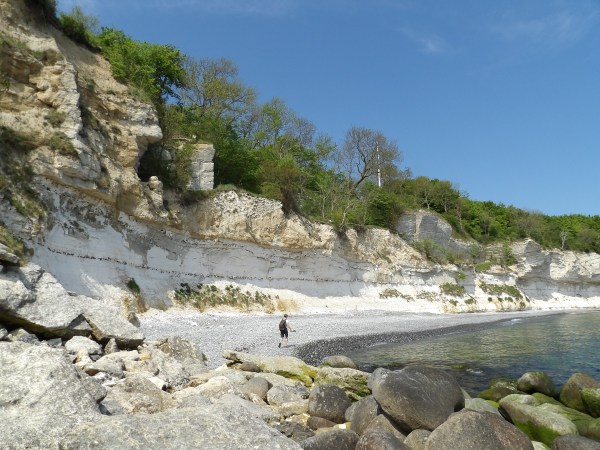
As the weather improved late in the spring, it brought back good memories of long cycling trips from the year before. I yearned to take a break and go out and explore again, so I convinced my flat-mate to join me on a day’s cycling trip to the chalky cliffs of Stevns Klint.
Stevns Klint
On a mid-May’s sunny day, we took the S-train to Køge, south of Copenhagen, and then hopped on our bikes for the rest of the 1.5 hour journey. Less memorable than the coastal road to Helsingør, the route to Stevns Kilnt took us across endless farmlands and a couple of small villages. Even if the trip there was rather dull, the destination more than made up for it.
Arriving at Højerup, a small town nearest to Stevns Klint
Located on the eastern coast of Zealand, Stevns Klint is a stunning 15-kilometer-long white chalk cliff that doesn’t just offer breathtaking views, but holds a story that changed the history of life on Earth. Recognized as a UNESCO World Heritage Site, this cliff is one of the most scientifically important locations in the world for understanding the mass extinction that wiped out the dinosaurs.
Where dinosaurs met their end
What makes Stevns Klint so unique is a thin, dark layer of clay found within its layers of chalk and limestone. Known as the “fish clay”, this band is rich in iridium, a rare element more commonly found in asteroids than on Earth. This thin layer marks the Cretaceous-Paleogene (K-Pg) boundary, about 66 million years ago, and provides compelling evidence that a giant asteroid struck Earth – the same event believed to have triggered the extinction of nearly 75% of all species, including the non-avian dinosaurs.
The chalky cliffs at Stevns Klint
As you can imagine, the cliff is a paradise for geologists and paleontologists. My flat-mate, also a geologist was ecstatic. Before moving to Denmark he worked as a paleontologist on a research project in Romania. This was right up his alley.
The fish clay-extinction band running along the side of the cliff
Fossils preserved in the chalk layers above and below the iridium-rich boundary reveal a vivid picture of life before and after the impact. Tiny marine organisms like foraminifera show a sharp decline right at the boundary, offering one of the clearest extinction markers in the world. Scientists continue to study Stevns Klint to understand not only how life vanished but also how it rebounded in the aftermath.
Bonus modern attractions
Surprisingly enough, Stevns Klint isn’t just about ancient history. The geological features of the cliff weren’t news to me, but as we discovered the area also had stories from more recent times. Perched dramatically at the cliff’s edge is Højerup Church, a medieval church built around 1250. At the time located safely inland, but over the centuries inching ever closer to the edge due to relentless erosion of the cliff.
Højerup Church
For generations, the local legend warned that the cliff was retreating, inch by inch. In fact, there’s a Danish saying: “The church moves one cock-step closer to the sea every Christmas Eve.” While poetic, that warning became very real on March 16, 1928, when a large section of the cliff collapsed, taking the entire eastern part of the structure with it. Immediately decommissioned for religious services, the locals rallied to preserve what remained of the church.
The back of Højerup Church inching towards the sea
Beneath the cliffs, hidden in the limestone, is another surprise attraction. Namely the Stevnsfort Cold War Museum, a once-secret fortress built to withstand nuclear attacks during the Cold War.
Stevnsfort
Built in 1953, at the height of Cold War tensions, Stevnsfort was part of NATO’s front line defense. Its strategic location on the coast of Zealand gave it a commanding view over the Øresund Strait, a crucial naval passage between the Baltic Sea and the North Sea. The fortress was designed to help detect and, if necessary, halt Soviet warships attempting to reach Western Europe.
Rocket artillery pieces on display in the museum courtyard
For decades, the site was fully operational and highly classified. It wasn’t until the early 2000’s that the base was officially decommissioned and turned into a museum. Even as a museum it’s so hidden from sight that we didn’t notice it until we were leaving Stevns Klint. Only then did the huge tank and rocket artillery on display in the courtyard catch my eye, spurring me to investigate.
Nothing like posing with the Centurion MBT in your cycling gear…
Unfortunately though, it was fairly late in the afternoon and we wouldn’t have had time for a proper visit before closing time. That’s one attraction I regret never taking the time to go back to while still living in Denmark.
Day trip to Sweden
A couple of months later, my friends and I were preparing for another excursion. I don’t recall how and why we decided on this, but we were basically going to visit Malmö in Sweden for half a day.
Located just across the Øresund strait from Copenhagen, Malmö is the third largest city on Sweden and the largest city in the southernmost province of Skåne. The two cities are linked by one of Europe’s most impressive feats of engineering, the Øresund bridge.
The Øresund bridge on a muggy morning, seen from the Danish side
Opened in 2000, this impressive structure not only connected the two Nordic cities, but also formed a vital artery between Scandinavia and the rest of Europe. Spanning approximately 16 kilometers in total, the crossing combines a 7.8 km cable-stayed bridge with a 4 km underwater tunnel, joined in the middle by an artificial island named Peberholm. Accommodating both a 4-lane motorway and a dual-track railway, the bridge has become a cultural icon, famously featured in Nordic noir television and admired for its sleek design and ambitious scale.
The Øresundståg train, was the most convenient option for us. You can board it at several stations on the Danish side, including Copenhagen Central, Nørreport, Østerport stations, as well as Kastrup at Copenhagen Airport. The ride lasted about 40 minutes from downtown Copenhagen. Before we knew it we were already in Sweden.
Malmö
Once an industrial port town, Malmö has undergone a drastic transformation into a modern, eco-conscious city. So much so that it has taken the top on the list of Europe’s greenest cities.
Walking around Malmö
One of the most striking symbols of Malmö’s reinvention is the Turning Torso, a twisting skyscraper designed by Santiago Calatrava, which towers over the city’s redeveloped Western Harbour (Västra Hamnen). This area, once a shipyard, is now a model for sustainable urban living, featuring energy-efficient buildings, green spaces, and a popular seaside promenade.
The Turning Torso skyscraper in Malmö
Close encounter of the green kind
Malmö is also known for its strong tradition of activism and social engagement. It has long been a politically progressive city, often leaning left in Sweden’s political spectrum. It has a history of grassroots organizing and is home to numerous NGOs, cultural centers, and activist groups advocating for equality, justice, and environmental sustainability. I bring this up because even during our short visit we ran across activists engaging with people on the streets.
Dude just casually kite surfing the canals in Malmö
In our case, it was a vocal group advocating for veganism to combat animal cruelty and industrial farming through reduction of meat consumption. As much as we sympathized with the cause, we were not really the right target audience for their campaign, as at least at the time, we were all uncompromising meat-eaters. This lead to a few snarky remarks and “troll-face” exchanges, which the activists were not pleased with.
We weren’t there to please them, of course, just to explore and have a bit of fun, even if it meant rolling our eyes at a few preachy, virtue-signaling activists parading their self-fed moral superiority for all to admire.
Old town
Despite its modernity, Malmö still honors its historical roots. The medieval Stortorget and Lilla Torg squares are nestled among charming cobblestone streets in the old town, while landmarks like St. Peter’s Church offer a glimpse into the city’s rich past.
Statue of Karl X Gustav in Stortorget
The architecture in this area showcases the city’s rich history, with a blend of Renaissance, Baroque, and Neo-Gothic styles, similar to Copenhagen’s historic center. The nearby Malmöhus Castle, a Renaissance fortress now housing museums and exhibitions, stands as a testament to centuries of regional history.
Ready to go home after a day of exploring Malmö
After walking around the harbor and central areas for a few hours, we plopped down in the city’s main square and soaked in the afternoon sun. With a pleasant day of city-exploring behind us, we were ready to head back to the train station and Copenhagen.
I had arrived in Copenhagen, Denmark for the first time around mid-August 2015. I was about to begin my two-year Masters program in Geoscience at the University of Copenhagen (Købehavns Universitet) in September. Prior to the start of the semester, KU, short for Købehavns Universitet, organized a two-week welcome and introduction program for international newcomer students. This started off with a big amphitheater presentation and welcome event and then branched out into multiple trips and tours across campus and the city of Copenhagen.
Frederiks Church seen from the waterway, Copenhagen, Denmark
Another part of their international students program was what they called the mentor program. This program basically paired volunteer second-year students with newcomers to form groups where the veterans could propose, organize and lead social/cultural events. All with the intent to help newcomers familiarize themselves with the local culture and help them settle into their new lives. This was all sponsored by the university.
Hanging out with the mentors group in Frederiksberg Park, Copenhagen, Denmark
Regarding their treatment of international students, I have nothing but praise for KU. Their international student integration programs were the best I’ve experienced. I’ve not only felt welcomed and at home from day one of stepping foot on their campus, but have made dozens of friends from across the world through their programs and events. That being said, for anyone reading this and considering applying for a study program at KU, I would highly, highly recommend it! Seriously, BEST University hands down!
Those first weeks at KU
One of the first mentor program events I attended was a cultural boat trip along Copenhagen’s canals. There I met up with a couple of students, Bjørn and Martin, whom I befriended during the welcome event. We got a full tour of the city sights along the canals and old city port.
Bjørn, Martin and I taking the boat tour across the city canals, 2015
The last week before September, KU held their annual welcome event to all students in their main courtyard on Nørregade 10. Since the university has four campuses spread across the city, it can be hard to track what’s going on where. But Nørregade 10 is where they have their old administrative center, student center and big library. It’s a beautiful old building with rich history, dating back to 1479, the founding year of the University of Copenhagen.
A winter photo of the University of Copenhagen’s old main building located in central campus, downtown Copenhagen
A friend for life
The dean gave his annual speech to a big crowd of local and international students after which we were free to roam around. Here I met up with other fellow students from the welcome event. One of them was an American guy by the name of Leo, whom I kept calling Steve, because I kept forgetting his name. I told him that I thought all Americans were called Steve. He loved it and suggested I instead call everyone Chad, just to annoy them.
Inside the university’s main building, exploring the lavish wall-covering paintings
Another student was a Nigerian guy name Oluwaseun Edward, who was also there to study Geology. I remembered him from back at the welcome presentation. He was the guy waving at me from a few rows away in the big amphitheater pointing to his tag and yelling out GEOLOGIST! We walked around exploring the halls of the old KU building together. Later on we grabbed a kebab from my favorite Turkish kebab place in Copenhagen. Afterwards we went on to discover every KU-students go to bar/café meetup place, Studenterhuset (Student House). My brother from another mother, father and continent, Eddy would become one of my best friends to date.
Eddy, myself and Christian rocking Nigerian colors
Several weeks later, Eddy and I would take the opportunity to visit Møns Klint through another KU mentor’s event. One of several “Klints” Møns Klint is a famous coastline on the island of Møn, a couple of hours south of Copenhagen. A favorite leisure destination for locals and foreigners alike, Møns Klint offers rocky beaches and hiking trails along a series of impeccably white chalky cliffs meeting the Baltic Sea.
The chalky cliffs and beaches of Møn’s Klint, 2015
More friends
Throughout that first semester, as well as the coming years, I’ve had endless memorable moments and stories from KU. There was the time I met Bjørn’s computer scientist gang during a tour of KU’s Frederiksberg campus. Among them were Ivo and Venko from Bulgaria who named my shitty bike “Shame”. Bogdan and Raluca from Romania and Martin and Klaudia from Slovakia.
Celebrating our friend Venko’s birthday with the entire computer scientist gang, 2018
We were quite a large group of students on the tour. At one point we were all heading towards one of their buildings on campus. If memory serves, the building had a set of revolving doors and a couple of normal ones. So for no apparent reason everyone starts lining up to those revolving doors and it’s just taking forever to get everyone in one by one. Baffled by this, I simply step out of line and head towards one of the free doors to go through. Later on I meet Raluca and Bogdan and when she finds out I’m from Romania she starts laughing out loud. She says she could have sworn I was Romanian the moment she saw me bypass that pointless que and head for the free door.
My farewell dinner with the gang in 2019 before I moved away from Denmark
KU campus rocks!
There was another time when I found out about the “do-it-yourself student run bicycle repair shop” on KU campus. I briefly mentioned this in my previous post. After having some issues with my rusty old bucket of bolts bike named Shame, I ended up going to this shop quite a few times. I learned from other students there how to maintain and fix up bikes. There were a bunch of abandoned old bikes that could be scavenged for parts. Soon enough Shame had a shiny new chain, slick new rubber tires, a working hand break and a few other much needed components!
An upgraded Shame that I had enough faith in to let my mom use while she was visiting in 2016
Even after finishing our studies two years later, my friends and I still spent time on campus and Studenterhuset. One of those times we had met a fellow aspiring guitarist from Hungary. After jamming out, we went to Studenterhuset for a few drinks. Once there we overheard that a girl at a neighboring table was celebrating her birthday. I don’t remember how, but so we ended up serenading her on the spot with a totally improv birthday song.
Guitar practice session with Bogdan on the beach
Truly I could go on and on… But at the heart of each story lay a common theme: Amazing people and fantastic friends!
The mentees become the mentors
Eddy and I began our first student semester as mentees at KU. We both participated in several fun events, like the ones I mentioned above. During this time we had the chance to meet a lot of new people, see new places and really get accustomed to Danish life. We both wanted to have a chance to help other newcomers and give them the same welcoming treatment that we got.
At Møn’s Klint during fall 2015, back when Eddy and I were mere mentees
Thus, one year later, Eddy and I volunteered to be mentors at KU. Together with our common friend Irene, a Danish girl we met during our mentee days, we helped create and host various events for the new batch of mentees in 2016. From drinks and dinner nights, to Lego building and bike trips through Deer park.
At Bakken in 2016 when we were now full-blown mentors guiding our newcomer international students
Once more, we had the chance to meet a bunch of new people and forge even more friendships with students from across the world.
What about the Danes?
Thus far, I’ve mostly mentioned international students, but you might ask, what about the Danes? You may have heard, or read that Scandinavians in general are more cold and distant. Perhaps even unfriendly? Well, that’s completely false in my opinion.
Eddy and my Danish friends supporting me on the day I defended my Masters Thesis, 2017
Yes, as a foreigner you tend to find it easier to befriend other foreigners that are like you, alone, in an unfamiliar land. Also yes, Danes might be a bit more reserved, but not because they’re cold, or unfriendly. But because they grew up there and already have their friend-groups and all. You as the foreigner usually need to make those extra steps in the beginning to integrate into their world. But once you do, you will find that Danes are some of the nicest people you could ever meet.
Danish friends
My first attempt at befriending Danes was during one of our classes. We had to work on a task in groups and I ended up in a group with three Danes who were clearly good friends, Glenn, Jesper and Jonas. We were supposed to interpret a series of squiggly seismic lines. I made a stupid joke about how some of those lines looked like Batman. The three Danes laughed and said I joined the right group. Next thing I knew, Jesper and Glenn gave me gift for my birthday a couple of months later. This simple kind gesture will stay with me forever.
Me and Jesper checking out the displays in Frederiksborg Castle, Hillerød, 2016
Then there was Lasse Gram, my good friend who in 2016 when I couldn’t find a place to stay after my dorm contract was up, offered me a room in his apartment. Then he would kick me out half a year later… No, no, I’m joking haha! I love ya Lasse old buddy! As I’m writing this, I recall one of my fondest memories with Lasse. It was years later at Copenhell Festival in 2019. After a long couple of days of concerts and drinking, we met up towards the end of last show. We sang along to Scorpions live performance of Winds of Change with our broken, tired voices. Brothers in arms and drinks forever!
Lasse and I at a Devin Townsend concert in Copenhagen, Denmark
There were many others, but I would also mention Irene again. The Danish girl I met through Eddy and the mentor program. Even though she moved to the UK for a while and later on I would move away from Denmark, we stayed in touch. In fact, we are in touch to this day and send each other memes on a regular basis.
The best period of my life
Years after moving from Denmark to Canada, I still think of my “Danish” years as the best period of my life. It was certainly not all sunshine and rainbows. I will touch upon the hardships of those years in some of my next posts. Yet still, I generally felt a lot happier than.
I’ve had these past years to reflect on why that is. I’ve recently come to the conclusion that it was because of all the amazing friends I had.
Lost in thought in the “wilds” of Bakken
Don’t get me wrong, I had friends in Romania too and I now have friends in Canada. But Denmark was something else. I had groups upon groups of friends. From my Danish fellow Geologist friends, to the dozens and dozens of friends I made through Eddy and the mentor program, as well as my amazing computer scientist friends that I met through Bjørn.
The Machine thirsts for one more beer!
When I started taking Danish classes in 2016, I met even more people there. Some like Thomas from Germany, or Subi from Nepal would leave and return to their countries soon after. But others like Marios from Greece would stick around long enough for us to hang out and become good friends.
Going for drinks with Marios, Subi and Thomas after our first Danish language class in 2016
In my last year in 2019, I had to attend a job center training course for a few months and even there I made new friends. I will never forget the laughs I had with Makis and Anestis during those days. Without even trying, I was more socially active those years than ever before and ever since.
Having a BBQ with my Greek friends in 2019
Nothing lasts forever
Sadly, even the best of friendships can end in a glimpse. One of my best friends from Romania, would end up joining me and moving to Denmark in 2017. I couldn’t wait to integrate him in all of my friend groups. We had a great time for over a year. Yet something happened in 2018 between us that I still don’t fully understand. A falling out that broke what I thought was an unbreakable brotherly bond.
Rip friendship – 2018
Without him ever fully explaining his reasoning, my understanding was that he had gotten upset over something I said during one of our nights out. He walked off and refused to speak to me, even though we had been close friends for a decade and lived together at that point in time. On my end I felt confused and disrespected. Then I felt betrayed. I became angry and unforgiving.
Later, I tried to make amends and to a certain degree it worked. Then one day he left and went back to Romania without ever telling me. Before all ties were broken forever, I sent him one last farewell message where I wished him the best in his future.
Just like that a decade-long friendship had been extinguished. Indeed, nothing lasts forever. My time in Denmark wasn’t destined to either. Not because I didn’t want it to, or try, but fate it seems had other plans. To end on a positive note however, I’m happy to say that all of the friendships I forged during my years in Denmark have stayed intact to date.